10 Reasons to Digitize & Centralize Your Lab's EHS Data (and What It Actually Delivers)
Understand risks, protect your data, spend your budget where it counts, and more.
Download Whitepaper
TL;DR
Digitizing and centralizing laboratory EHS (Environmental Health and Safety) data replaces paper, spreadsheets, and staff memory with one real-time system that cuts safety reports from days to minutes and lifts training compliance above 80%.
- The real cost
The National Safety Council valued U.S. work injuries at $176.5 billion in 2023, with 103 million workdays lost, most of them preventable. When EHS data sits in binders, spreadsheets, and individual memory, you cannot catch risks early, answer auditors quickly, or keep safety knowledge when staff leave.
- What you gain
A centralized EHS system gives real-time visibility into hazards, training, and chemical inventory, plus audit-ready reporting in minutes and nightly data backups. Researchers and safety staff get hours back each week, and Boston College used its SciSure data to justify hiring two new Lab Safety Specialists.
- Digital EHS is now standard practice.
In a 2025 industry analysis, more than three-quarters of compliance leaders called digital EHS technology the only scalable way to manage inspections, certifications, and audit trails across sites, and Verdantix expects AI-enabled EHS software to be standard by 2026.
- The SciSure platform
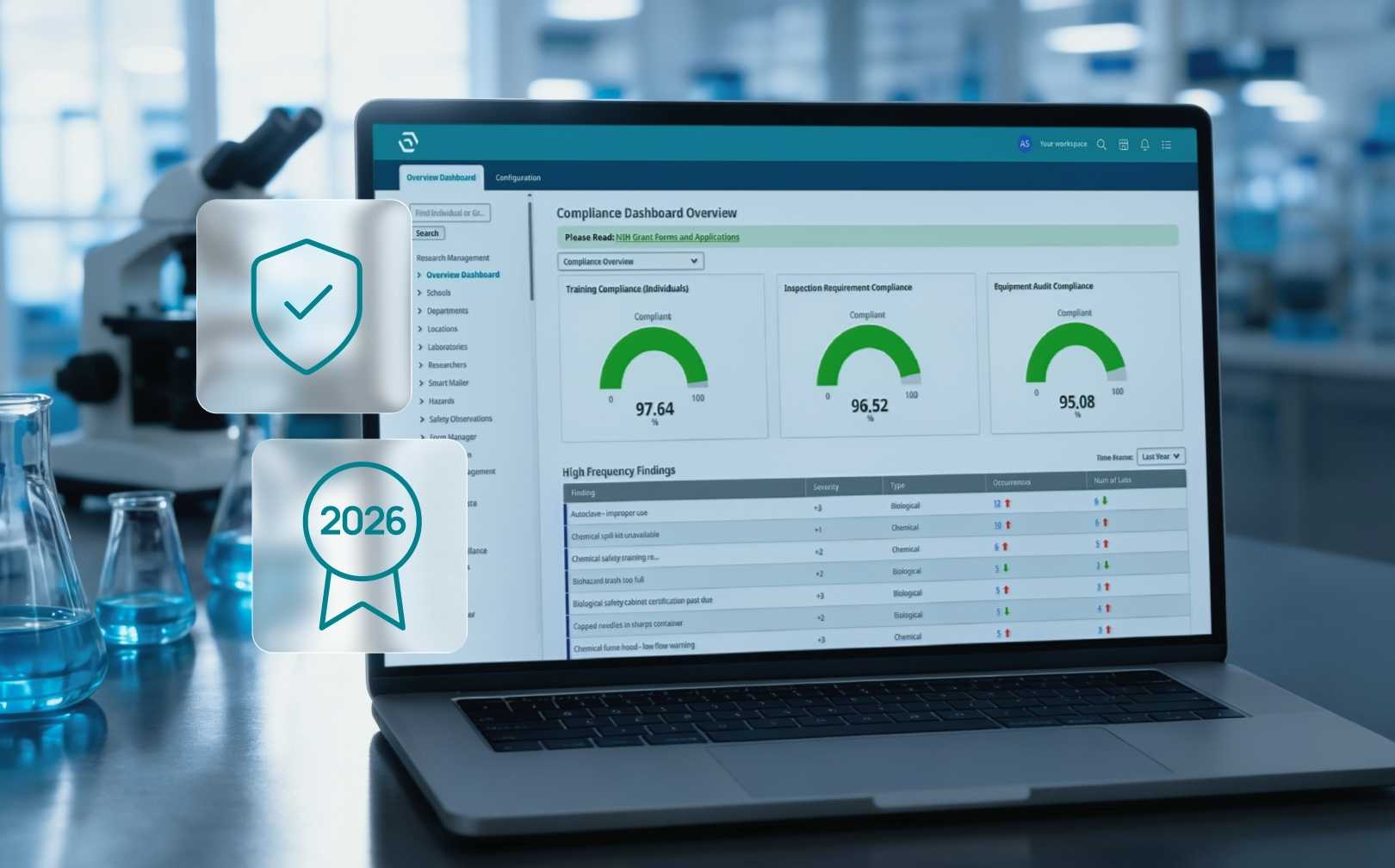
SciSure is a Scientific Management Platform, formed from the merger of eLabNext and SciShield, that unites the ELN (Electronic Lab Notebook), LIMS (Laboratory Information Management System), and Health & Safety (EHS). Chemicals, hazards, training, inspections, and incidents live in one place, keeping EHS data searchable, real-time, and audit-ready.
This post was originally published in 2018 and has been fully updated to reflect SciSure's positioning as a Scientific Management Platform, current industry research, and new customer results from Boston College and San Diego State University.
Ready to see SciSure in action?
No commitment · Free consultation
Running a safe, efficient research program comes down to two things: how well you use your resources, and how well you use your time. When both of those live in paper binders, scattered spreadsheets, and people's heads, you spend your day fighting the job instead of doing it. That's why so many universities, research institutes, and companies have moved their EHS (Environmental Health and Safety) data into software that digitizes and centralizes it.
The shift is now mainstream: in one 2025 industry analysis, more than three-quarters of compliance leaders said digital EHS technology is the only scalable way to keep up with the inspections, certifications, and audit trails they have to manage across sites. Tasks get done faster. Gaps in the safety program become obvious. And your researchers get to focus on research, because there's finally one place to look instead of ten.
Below are 10 reasons to make the switch backed by industry research, and by two universities that did exactly this to slash their two-week reports to ten minutes.
Read More: The 5 Best EHS Software Platforms For Labs in 2026
Why Should You Digitize & Centralize Your EHS Data?
The short answer: a single, real-time system shows you your risks the moment they appear, makes audits painless, and frees your team from hours of manual reporting. Here are the 10 reasons that matter most.
1. You'll actually understand your risks.
Unseen risk is expensive: the National Safety Council counted 103 million workdays lost to work injuries in the U.S. Likewise, the total cost of work injuries in 2023 came to $176.5 billion. The bulk of these are preventable: real-time data is how you catch those risks early. You know the minute a researcher's training lapses or a new chemical lands in one of your labs, so you can respond before it becomes a problem.
2. Your reports get fast and accurate.
When laboratory information lives in ten places, every report is a scavenger hunt. Put it in one system and you can pull an up-to-date radiological inventory or inspection report in minutes.
3. You can handle audits without the panic.
What happens when an auditor asks about training, lab hazards, equipment, or assets? Without a central system, a request like that can stall your team for days, or you might not find the information at all. With everything in one place, you're always ready.
4. You can find exactly what you need.
Which of your labs handle particularly hazardous substances? Has everyone been trained for the equipment they use? A central database lets you answer in seconds, without digging around or interrupting a single researcher.
5. Your institutional knowledge stays put.
When EHS staff leave, the safety knowledge stuck in their heads and their personal spreadsheets tends to leave with them. A central system keeps it: what one person knew is now something everyone on the team can reach.
6. Your data is protected.
Paper gets lost, burned, or soaked by a leaky pipe. Spreadsheets aren't much safer; they might get overwritten by a colleague, accidentally deleted, or lost to a crashed laptop. Software with nightly backups and disaster recovery survives all of that (and a spilled cup of coffee).
7. You spend your budget where it counts.
As your inspections, activities, and findings collect in one place, you can more easily spot trends and gaps. This helps you put your people and your funding where they'll make the biggest difference.
8. You can reach the right people instantly.
Good software lets you communicate inside the system, so you can send a targeted note to everyone with animal contact, or a chemical-safety reminder to specific lab groups. Replies stay on the record and in one place, instead of buried in your inbox.
9. You give everyone their time back.
Researchers and safety staff lose hours to filling out forms, compiling reports, and chasing down overdue items. This is exactly the admin-heavy, error-prone work that automation and AI are taking over: Verdantix expects AI-enabled EHS software to be standard by 2026. You'll see the proof in the two universities below, where reports that took days now take minutes.
10. You cut costs.
Workplace injuries are expensive, and most are preventable. The National Safety Council put the total cost of U.S. work injuries at $176.5 billion in 2023, and Liberty Mutual's 2025 Workplace Safety Index found employers pay more than $1 billion a week in direct workers' compensation costs for serious non-fatal injuries. Catching hazards before they turn into incidents is where the savings come from, and that starts with seeing them.
What Digitized EHS Data Looks Like In A Real Lab
After implementing SciSure, two university EHS teams went from scattered paper, spreadsheets, and guesswork to one real-time system, and the payoff showed up fastest in reporting: jobs that used to take days now take minutes. Here's what changed, in their own numbers.
At San Diego State University, EHS director Jennifer Ramil couldn't say how many lab spaces the university had, who worked in them, or what they were handling. The records technically existed in a facilities system, but as she put it, the information was "out of date yesterday."
At Boston College, EHS director Gail Hall had spent years cycling through paper binders, an Excel spreadsheet, and home-grown software. The problem, in her words, was "records here and records there." The goal was to centralize everything and link people to their labs, their hazards, and the right training.
Here's what digitizing their EHS data with the SciSure platform did for them.
Reporting dropped from days to minutes
The clearest win was time. At Boston College, a report listing every lab group and its PIs (Principal Investigators) used to take all day. Now it takes 5 minutes. A list of everyone working with a specific hazard wasn't even possible before, and now takes about 15 minutes.
San Diego State's numbers are just as stark:
- A report of users overdue for a course used to take an hour. Now it's 3 minutes.
- A full training compliance report used to take 2.5 hours. Now it's 3 minutes.
- That same compliance report, formatted for a department head, used to take two weeks. Now it's about 10 minutes.
- Looking up one person's training records used to take several hours. Now it's 1 minute.
Training compliance climbed & stayed there
At San Diego State, training compliance rose from 56% to over 80%, and the team grew from 8 courses and roughly 500 completed records a year to 16 courses and more than 4,600 records.
Likewise, Boston College reports up to 97% compliance, and its Training LMS (Learning Management System) let the team drop an outside consultant they had been paying for biosafety training and audits.
Identifying who's due for a course, then writing and sending the reminder? At San Diego State that used to take days. Now, in Jennifer's words, it's "automated."
Guesswork turned into real-time visibility
San Diego State went from not knowing how many labs it had to reporting, with confidence, that 100% of the spaces where chemicals are used had been inspected. That visibility changed behaviour too: Jennifer's PIs started taking an active role in managing their own labs, which she called "worth its weight in gold."
At Boston College, pulling scattered records into one place finally let the team connect every person to their lab, their hazards, and their required training.
Both teams traded "I'm not sure" for "here's the answer."
The data made the case for more resources
At Boston College, the information the team could finally extract from SciSure showed senior administration the need for more people, and the university approved two new Lab Safety Specialists. Once leadership could actually see the hazards across campus, the staffing argument made itself. That same visibility lets EHS spot trends and justify budgets with evidence, instead of asking for resources on a hunch.
How SciSure helps you digitize your lab's EHS data
SciSure brings your chemical inventory, safety data sheets, hazardous waste, biosafety, inspections, incidents, equipment, and training into one connected system, so your EHS data is real-time, searchable, and audit-ready instead of scattered across binders and spreadsheets.
SciSure is a Scientific Management Platform (formed from the merger of eLabNext and SciShield) that covers the ELN (Electronic Lab Notebook), LIMS (Laboratory Information Management System) for sample and inventory tracking, and Health & Safety (EHS) in one place. For your EHS team specifically, that means:
- One source of truth.
Chemicals, hazards, training, inspections, and incidents live together, so you stop hunting across systems for an answer. - Real-time answers.
You see a lapsed certification or a newly added chemical the moment it happens, not weeks later. - Audit readiness by default.
When an auditor asks, the report is minutes away, not days. - Time back.
Your safety staff and your researchers get hours of their week returned, the way Boston College and San Diego State did.
Digitizing and centralizing your lab's EHS data helps you run a safer, more efficient research program with a return you can actually measure. But hey, don't take our word for it:
And if you want to see what your own reporting could look like at 5 minutes instead of all day, book a demo or talk to a SciSure specialist.

Read more of our blogs about modern lab management
Discover the latest in lab operations, from sample management to AI innovations, designed to enhance efficiency and drive scientific breakthroughs.