Lab Sustainability That Moves the Needle: Inside SciSure’s Partnerships with My Green Lab, Elemental Machines, and Polycarbin
Discover how SciSure and its partners make lab sustainability achievable, embedding measurable, actionable practices into everyday lab operations.
Download Whitepaper
TL;DR
Lab sustainability becomes achievable when standards, real-time data, and circular materials are integrated directly into everyday lab workflows through a connected digital platform like SciSure.
- Standards and Behavior
My Green Lab defines globally recognized sustainability standards for laboratories, focusing on behavior change, certification, and measurable practices. By embedding these frameworks into SciSure’s Scientific Management Platform (SMP), labs can align daily activities like equipment use, training, and procurement with verified sustainability guidance and industry benchmarks. - Operational Intelligence
Elemental Machines provides real-time equipment monitoring, environmental data, and analytics that make lab sustainability measurable. Through integration with SciSure SMP, labs gain visibility into energy use, asset utilization, and equipment performance, enabling proactive decisions that reduce waste, optimize infrastructure, and improve both sustainability outcomes and research efficiency. - Circular Materials
Polycarbin enables a circular economy for laboratory plastics by recycling non-hazardous waste into certified lab-grade consumables. Its Carbin Counter platform delivers ISO-aligned, real-time sustainability metrics, helping labs track waste diversion, carbon savings, and Scope 3 emissions while maintaining compliance with scientific and regulatory standards. - Integrated Workflows
SciSure connects sustainability standards, equipment intelligence, and material data within a single digital lab environment. This integration embeds sustainability into core workflows such as safety, compliance, inventory, and procurement, allowing scientists to act on sustainability insights without disrupting research operations or relying on separate reporting systems. - Ecosystem Approach
Sustainable science requires collaboration across the lab ecosystem. SciSure’s partnerships with My Green Lab, Elemental Machines, and Polycarbin create a unified model that links standards, data, and materials. This ecosystem approach transforms lab sustainability into a continuous, data-driven operational capability rather than a fragmented or symbolic initiative.
Ready to see SciSure in action?
No commitment · Free consultation
Across the scientific ecosystem, lab sustainability has entered a new era. What was once treated as a reporting obligation has become a redesign challenge touching every part of the scientific value chain – from how labs operate and purchase equipment to how organizations plan, invest, and measure long-term impact.
Industry leaders increasingly see sustainability as a core business issue: shaping strategic priorities, influencing operational decisions, guiding capital allocation, and strengthening organizational resilience. The environmental agenda no longer competes with commercial performance – the two are fast becoming inseparable. Strong sustainability capability reduces risk, protects supply continuity, improves asset utilization, and prepares organizations for rapidly evolving expectations from regulators, investors, and health systems.
Despite this shift, lab sustainability remains one of the hardest areas to address. Labs are energy-intensive, process-heavy, and behaviorally complex environments. Real progress requires alignment between standards, equipment intelligence, and daily operational practice – not isolated initiatives or symbolic gestures.
At SciSure, we believe the only way to achieve meaningful, measurable improvement in lab sustainability is through collaboration. No single organization can solve the sustainability challenge in isolation. Standards must guide behaviors; data must reveal what’s actually happening inside equipment; and digital workflows must translate both into everyday action.
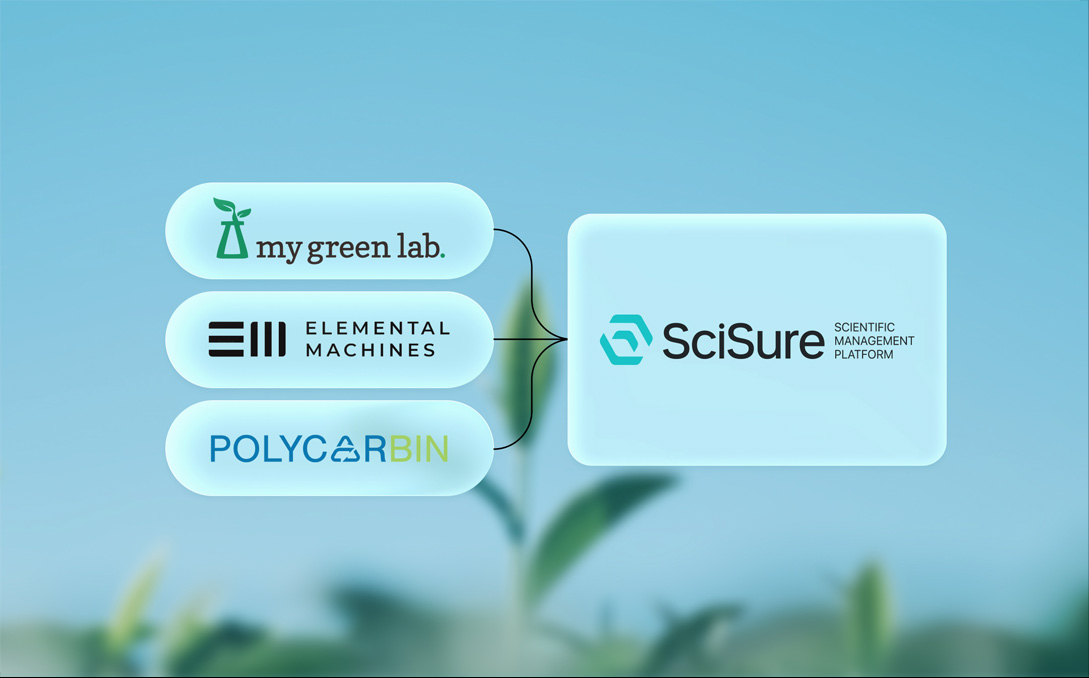
That’s why SciSure chose a collaborative approach to its sustainability mission; forging partnerships with organizations that are leading the way in their respective sustainability domains:
- My Green Lab, the global authority defining what sustainable laboratory practice looks like.
- Elemental Machines, the equipment intelligence platform that makes sustainability measurable and actionable.
- Polycarbin, the circular economy platform helping labs reduce waste and adopt more sustainable consumables.
To shine a light on these exciting partnerships and what they mean for SciSure customers, we spoke with James Connelly, CEO of My Green Lab, Kevin Ghiasi, VP of Global Alliances at Elemental Machines, and James O’Brien, Co-founder and CEO of Polycarbin. Their insights reveal how standards, equipment intelligence, and digital lab workflows combine to help SciSure Scientific Management Platform (SMP) users move from ambition to truly sustainable operations.
My Green Lab: Building the culture and standards behind lab sustainability
Improving lab sustainability can feel like a daunting challenge, particularly in environments built for precision, safety, and scientific performance. From energy-intensive equipment to complex waste streams, labs have historically been among the most resource-intensive environments around. Yet many of the most effective sustainability improvements are surprisingly practical, rooted in better habits, clearer standards, and consistent measurement.
This is the space where My Green Lab has become a global leader. Through its widely adopted certification programs, educational initiatives, and sustainability frameworks, the organization has helped thousands of laboratories embed sustainability into their daily operations. Today, My Green Lab Certification is widely recognized as a leading standard for sustainable laboratory practice, adopted by many of the largest pharmaceutical and biotechnology organizations.
For James Connelly, CEO of My Green Lab, the biggest barrier to improving lab sustainability is not a lack of awareness. Scientists increasingly understand the environmental impact of laboratory operations. The real challenge lies in translating that awareness into consistent daily habits across complex research environments.
“A lot of sustainability ultimately comes down to behavior change. You have to build a culture where everyone is thinking about sustainability as part of how they do their work every day. Many of the improvements are actually very straightforward: things like closing fume hood sashes, turning off equipment when it’s not in use, or consolidating autoclave and washer loads. But those small actions, when adopted consistently across an organization, can drive very significant environmental and energy savings.”
These practical adjustments may appear incremental in isolation, but across large research institutions they compound into meaningful improvements in sustainability. Equipment usage, freezer management, waste segregation, and procurement choices all influence the environmental footprint of laboratory work.
While behavior change is essential, James emphasized that lasting progress requires structure and accountability. Without consistent frameworks and credible measurement, sustainability initiatives risk becoming fragmented – or worse, performative.
“It’s important that sustainability programs are meaningful and verifiable. Certification needs to be measurable, independently audited, and repeatable across laboratories. Otherwise, it risks becoming a checkbox exercise rather than something that actually changes how labs operate.”
This emphasis on verification has shaped the My Green Lab Certification program, which pairs education and behavioral guidance with independent auditing to ensure laboratories are implementing recognized best practices. The framework also includes tools that help organizations estimate environmental and financial benefits from sustainability improvements, reinforcing the connection between responsible laboratory operations and long-term organizational performance.
“One of the challenges the industry faces is that many sustainability claims are difficult to compare or verify. Standards and third-party certification create a level playing field, so organizations can make informed decisions and ensure that sustainability improvements are real and measurable.”
Beyond operational practices inside the lab, My Green Lab has also expanded its influence across the broader research ecosystem. Programs such as the ACT EcoLabel introduce standardized environmental impact labels for laboratory products, allowing procurement teams to compare equipment and consumables based on verified sustainability metrics. As life science organizations increasingly extend sustainability expectations to suppliers and research partners to address scope 3 emissions, these standards are becoming an important part of how organizations approach lab sustainability across the value chain.
Embedding sustainability standards directly into the digital lab
For SciSure, partnering with My Green Lab reflects a strategic choice. Rather than attempting to replicate sustainability frameworks that have been developed and refined over many years, SciSure chose to collaborate with the organization already helping define global best practices for lab sustainability. The goal is not to reinvent sustainability standards, but to make them easier for laboratories to adopt by embedding them directly into the digital systems scientists already use.
From My Green Lab’s perspective, SciSure also represented a natural partner for advancing sustainable lab practices. Because the platform is already embedded across leading research institutions worldwide, it provides a direct connection to the environments where impactful sustainability decisions are made every day.
In practice, this partnership connects My Green Lab’s educational resources and sustainability frameworks with the digital workflows that manage safety, inventory, and compliance inside the SciSure SMP. This allows sustainability guidance to appear alongside the operational tasks scientists already complete, from training and chemical management to equipment oversight and compliance documentation.
By aligning sustainability practices with everyday operational processes, the collaboration helps lab teams move beyond standalone initiatives and integrate lab sustainability directly into their routine lab activity.
“Partnerships allow sustainability programs to reach scientists where they’re already working. If you can integrate sustainability education and guidance into the digital tools labs already rely on for safety, compliance, and operations, it becomes much easier for people to adopt meaningful practices while still ensuring that the results are measurable and verifiable.”
Looking ahead, the collaboration will continue to deepen as SciSure works to bring My Green Lab training programs and sustainability guidance directly into its platform environment. This will allow laboratory teams to access sustainability education alongside other required safety and compliance training, creating a more seamless pathway from awareness to action.
“The most important thing labs can do is start. There are practical steps that any lab can implement today, and when those actions are supported by the right standards and tools, they can deliver meaningful improvements in sustainability.”
By aligning globally recognized sustainability standards with digital lab workflows, the partnership helps SciSure customers take a more structured approach to lab sustainability—connecting education, behavior, and operational oversight within the systems scientists already rely on every day.
Elemental Machines: Turning lab sustainability into measurable operational intelligence
While My Green Lab helps define scientific sustainability standards, achieving meaningful progress also requires visibility into how laboratory environments and equipment actually perform. Sustainability frameworks establish best practices and guide behavior across the lab, but turning those principles into measurable operational improvements depends on understanding how equipment, infrastructure, and environmental conditions behave in real lab environments.
This is where Elemental Machines plays a critical role. Through connected sensors, environmental monitoring, and advanced analytics, the platform provides laboratories with continuous insight into how equipment, infrastructure, and environmental conditions behave in real time.
For Kevin Ghiasi, VP of Global Alliances at Elemental Machines, improving lab sustainability begins with establishing a reliable baseline of operational data.
“We see ourselves as the data foundation that makes sustainability measurable and actionable. Many labs want to improve sustainability, but they lack consistent visibility into equipment behavior, environmental stability, utilization patterns, and asset criticality. Without that baseline, improvement is difficult to quantify.”
In many labs, equipment such as ultra-low temperature freezers, incubators, and environmental chambers operate continuously with little insight into how often they are actually used or how efficiently they are running. Over time, this lack of visibility can lead to redundancies, unnecessary energy consumption, and equipment lifecycles that are shorter than they need to be.
By capturing environmental and equipment data through connected sensors and combining that information with structured analytics, Elemental Machines helps organizations identify inefficiencies that would otherwise remain hidden. This includes monitoring temperature stability, tracking equipment utilization, and evaluating the operational criticality of assets across the lab.
“Sustainability often follows operational discipline. When labs have structured data about how equipment is being used and how critical it is to operations, they can make more informed decisions about energy use, asset management, and resource allocation.”
One of the most significant shifts enabled by this type of monitoring is the move from reactive to proactive lab management. Rather than discovering inefficiencies after the fact, laboratories can identify opportunities to optimize operations as they occur.
“Sensor-driven monitoring allows labs to move from reactive operations to proactive operations. When you combine environmental monitoring with utilization data and criticality scoring, you can identify equipment that doesn’t need to run continuously, consolidate workloads onto fewer assets, and safely power down low-criticality devices during idle periods.”
These adjustments can have a substantial decarbonization impact, particularly in energy-intensive research environments. Underutilized or redundant equipment can significantly increase both energy consumption and operational costs. By revealing usage patterns and asset importance, laboratories can make informed decisions about consolidating equipment, retiring aging assets, or adjusting operating schedules without compromising scientific productivity.
Beyond energy savings, this level of operational insight also helps laboratories protect the integrity of their scientific work. Environmental stability monitoring can alert teams to temperature fluctuations or equipment performance issues that could compromise sensitive samples or experimental results.
Integrating equipment intelligence into the digital lab
For SciSure, the partnership with Elemental Machines adds a critical measurement and detection layer to the broader sustainability ecosystem being built across the platform.
Through integration between the two platforms, environmental monitoring and equipment intelligence from Elemental Machines can be connected directly to the operational systems scientists use to manage their work inside SciSure. This empowers labs to see how equipment conditions and performance relate to the samples, materials, and workflows managed within the digital lab environment.
Instead of sustainability metrics being reviewed separately from day-to-day research activity, environmental data becomes part of the same operational context as everyday research activities.
“Integration allows operational data to inform systems of record. When environmental intelligence and equipment utilization insights are embedded directly into workflow systems like SciSure, organizations can align procurement decisions, maintenance strategies, and equipment lifecycle management with real operational data.”
This kind of integration transforms sustainability from a retrospective reporting exercise into an ongoing operational discipline. Laboratories can monitor equipment performance continuously, identify inefficiencies early, and adjust practices in ways that improve both environmental outcomes and research efficiency.
Looking ahead, Kevin expects sustainability efforts across the life sciences industry to become increasingly data-driven, transparent, and integrated into broader operational decision-making.
“Over the next few years, sustainability will become more tightly connected to operational KPIs, governance, and risk management. Organizations will need objective, defensible metrics that demonstrate progress over time, and connected equipment data will play a foundational role in making that possible.”
For SciSure customers, the integration with Elemental Machines represents an important step toward making lab sustainability both measurable and operationally actionable. Instead of reviewing sustainability metrics in isolation, teams can see how equipment conditions, utilization patterns, and environmental stability intersect with the samples, materials, and workflows managed within the SciSure SMP.
This visibility empowers labs to identify inefficiencies earlier, optimize energy-intensive equipment, and make more informed decisions about asset utilization and infrastructure planning. By embedding equipment intelligence directly into the operational systems scientists already rely on, the partnership helps transform sustainability from a reporting exercise into a continuous operational discipline.
Polycarbin: Extending sustainability into lab materials and circularity
While standards and equipment intelligence are essential to improving lab sustainability, a significant portion of a laboratory’s environmental footprint lies in the materials it consumes and the waste it generates. Single-use plastics, packaging, and procurement decisions all contribute to Scope 3 emissions, making sustainable sourcing and waste reduction a critical part of the sustainability equation.
Historically, laboratory waste has been treated as an unavoidable byproduct of scientific progress, with large volumes of materials classified as hazardous and sent for incineration or landfill, even when they pose no such risk.
For James O’Brien, Co-founder and CEO at Polycarbin, addressing this blind spot is central to enabling more sustainable science:
“There’s long been this assumption in labs that everything is hazardous and nothing can be recovered. In reality, a significant portion of that material is non-infectious, non-hazardous, and perfectly capable of being diverted into closed-loop recycling streams.”
This misconception has helped sustain a fundamentally inefficient, linear model of consumption. Laboratory plastics are typically produced from fossil fuel-derived virgin resins, used once, and then discarded, creating both environmental impact and supply chain volatility.
Polycarbin’s mission is to replace this linear model with a circular one; recovering laboratory plastics and returning them to the supply chain as high-quality, lab-grade materials.
Through its closed-loop recycling platform, Polycarbin enables laboratories to divert a broad range of waste materials such as rigid plastics, pipette tip boxes, and PPE into dedicated recycling streams, where they are processed and remanufactured into new lab-grade products.
“We’re producing materials that are DNase-free, RNase-free, pyrogen-free, and tested to USP Class VI standards. There are absolutely applications where recycled materials can meet the performance and compliance expectations of modern labs.”
By maintaining these stringent quality standards, Polycarbin directly challenges one of the most persistent barriers to adoption: the assumption that circularity requires a compromise in scientific rigor.
For Polycarbin, circularity is only part of the solution. Ensuring that sustainability efforts are credible, measurable, and actionable is equally important. This is where the company’s Carbin Counter™ platform plays a central role, providing labs with real-time insight into the environmental impact of their recycling activities.
“One of the things we’re most proud of is Carbin Counter, our platform that tracks and quantifies the environmental impact of a lab’s recycling activity in real time. Labs can see exactly how much plastic waste has been diverted from landfill, what their carbon savings look like, and how they’re trending against their own sustainability goals.
That visibility changes behavior — it turns recycling from a passive act into something teams can rally around and improve over time. It creates a culture where sustainability is a metric people actually care about, not just a value statement on a website.”
Built on ISO-compliant, third-party verified life cycle analysis, the platform enables organizations to connect everyday lab activity with defensible sustainability metrics—supporting ESG reporting, regulatory compliance, procurement decisions, and Scope 3 emissions tracking.
Making circularity operational in the digital lab
While visibility and circular systems are essential, implementing these approaches in real-world lab environments requires alignment with existing workflows, safety requirements, and regulatory constraints.
This is where Polycarbin’s partnership with SciSure becomes critical.
By integrating with SciSure, Polycarbin can align its recycling programs with the workflows, safety classifications, and compliance requirements already defined within the digital lab environment. This provides a clearer, more structured view of laboratory operations, helping teams identify which materials can be safely diverted, ensure appropriate training, and scale sustainability initiatives with confidence.
“In labs that use SciSure, there’s a much clearer picture of what’s happening across workflows. That makes it significantly easier to introduce sustainable practices in a compliant, scalable way.”
More broadly, the partnership reflects a shift toward sustainability as an operational capability, rather than a standalone initiative.
“Sustainability becomes much easier to address when you have a well-run, well-organized lab. Platforms like SciSure provide that coordination layer, making it easier to adopt solutions like ours and embed them into everyday operations.”
By extending sustainability into materials, procurement, and waste workflows, Polycarbin addresses a critical but often overlooked part of the lab sustainability challenge. In combination with the standards provided by My Green Lab and the operational intelligence delivered by Elemental Machines, this creates a more complete picture of what sustainable science requires: connecting how labs operate, what they measure, and what they consume into a truly circular, data-driven system.
Bringing standards, data, and workflows together for more sustainable science
Improving lab sustainability is not a challenge any single organization can solve alone. Labs operate within complex ecosystems of technologies, suppliers, infrastructure, and scientific workflows. Meaningful progress requires collaboration across that ecosystem – bringing together the standards that guide behavior, the data that reveals operational realities, the materials and procurement decisions that shape environmental impact, and the systems that turn all of these into consistent daily practice.
As Jon Zibell, VP of Partnerships at SciSure, explains, advancing lab sustainability depends on connecting these elements through strong, purpose-built partnerships.
“Sustainability in the lab isn’t driven by any single solution, it requires a connected ecosystem of trusted partners working together to deliver real value to shared customers. At SciSure, we’re focused on breaking down data silos between applications, reducing administrative burden, and creating a more seamless, intuitive user experience through integrated technologies. We’re always looking to partner with leading organizations like My Green Lab, Elemental Machines, and Polycarbin to expand that ecosystem and accelerate impact across the industry.”
SciSure’s sustainability partnerships reflect this philosophy. My Green Lab provides globally recognized frameworks, education, and certification standards that help laboratories establish credible sustainability practices. Elemental Machines contributes the operational intelligence needed to understand how equipment, infrastructure, and environmental conditions behave in real time. Polycarbin extends this ecosystem into materials and circularity, enabling labs to reduce waste, adopt more sustainable consumables, and embed closed-loop practices into their operations.
Together, these capabilities provide both the standards, data, and material systems required to improve sustainability in scientific research environments. But translating those insights into everyday practice requires another critical element: operational integration.
Through the SMP, SciSure connects sustainability frameworks, equipment intelligence, circular material flows, and laboratory workflows within a single digital environment. Scientists can access training, manage safety and compliance processes, monitor equipment conditions, make more informed procurement decisions, and track environmental performance through the same systems that govern their daily lab operations.
As sustainability expectations across the science industry continue to grow, collaboration will only become more important. By bringing together partners like My Green Lab, Elemental Machines, and Polycarbin, SciSure is delivering on its mission to make safer, smarter, and more sustainable labs achievable—helping research organizations move toward a more tangible, coordinated, data-driven approach to lab sustainability.
Because solving the sustainability challenge will not come from any single tool or organization, but from ecosystems working together to drive meaningful change.
Ready to make your lab’s sustainability efforts more measurable and actionable? We’re here to help. Contact our team to discuss how SciSure can support your sustainable future.

Read more of our blogs about modern lab management
Discover the latest in lab operations, from sample management to AI innovations, designed to enhance efficiency and drive scientific breakthroughs.