5 Common Questions From Chemical Regulators & How to Address Them
Learn the five chemical regulator questions labs hear most often, from inventory accuracy and SDS access to labeling, storage, emergency response, and audit-ready records.

Download Whitepaper
TL;DR
Chemical safety inspections hinge on whether your inventory, safety data sheets (SDSs), labels, storage, and training records are current, searchable, and tied to the hazards physically present in your lab, and the most reliable way to pass is keeping that data live in a daily-use system rather than scattered across spreadsheets and binders.
- The rules are changing.
OSHA's Hazard Communication Standard requires chemical labels, SDSs, and worker training, while EPA's EPCRA (Emergency Planning and Community Right-to-Know Act) Sections 311-312 mandate annual Tier II inventory reports by March 1. The 2024 update adopted the Globally Harmonized System (GHS) Revision 7, and OSHA extended the first substance evaluation deadline to May 19, 2026.
- Prioritize tracking at the container level.
Regulators expect a container-level inventory showing each chemical's identity, location, quantity, owner, hazard class, and CAS (Chemical Abstracts Service) number, reconciled on a set schedule. The National Academies' Prudent Practices in the Laboratory stresses this, and the same live data lets first responders and local fire departments identify flammables, oxidizers, corrosives, and reactives fast during a spill or fire.
- Your documents should match containers.
Workers must reach the correct SDS during their shift, searchable by chemical name, CAS number, and manufacturer, with hard copies available if the electronic system fails. Labels on primary and secondary containers must stay legible and state the chemical identity and hazard warnings, so each container links cleanly to its SDS, storage rule, and inventory record.
- Storage follows hazard.
Proper storage means separating incompatible chemicals, capping flammable-liquid quantities per control area, and keeping flammables in approved cabinets, per Prudent Practices and OSHA laboratory guidance. A system that totals flammables by control area or flags expired peroxide formers and deteriorated containers catches problems before a fire marshal turns a housekeeping issue into an inspection finding.
- What an audit-ready lab looks like in practice.
The Engine Accelerator, a Cambridge tough-tech accelerator, scaled from 10 to 50 resident companies and cut hazard-identification time from hours to under five minutes after adopting SciSure's ChemTracker. Before the next visit, reconcile three rooms against your records, test SDS search, and confirm who owns HazCom and training updates.
This post was originally published in 2019 and has been updated to reflect the newest regulatory standards in lab safety and compliance and a customer story from MIT's Engine Accelerator highlighting their use of SciSure's ChemTracker module.
Ready to see SciSure in action?
No commitment · Free consultation
Chemical regulators are usually trying to confirm that your inventory, emergency access, SDSs, labels, storage, and training records are current, searchable, and tied to the real hazards in your lab.
That may sound like a lot, but the pattern is pretty simple: regulators want to see whether your chemical safety program works on an ordinary Tuesday, not just during inspection week. OSHA's Hazard Communication Standard requires employers with hazardous chemicals to maintain labels and safety data sheets and train workers to handle chemicals appropriately. Likewise, EPA's EPCRA Sections 311-312 rules require covered facilities to share SDS or hazardous chemical lists and submit annual inventory reports for reportable chemicals by March 1.
The rules are also moving. OSHA updated the Hazard Communication Standard in 2024 to align primarily with the seventh revision of GHS and improve label and SDS information. On January 15, 2026, OSHA also extended the first HCS 2024 substance evaluation deadline from January 19, 2026 to May 19, 2026 and extended the other compliance dates by four months.
In plain English: if your chemical data is stale, disconnected, or hard to explain, it's only getting harder to defend. In this post, we'll cover the five questions you would expect to hear, plus how to answer them before someone with a clipboard is standing in your doorway.
Why do first impressions still matter during a chemical inspection?
First impressions matter because regulators use your first few answers to judge whether your chemical safety program is controlled, current, and credible. If you can quickly show what chemicals are present, where they are stored, which SDSs apply, and how your team handles training and inspections, the visit starts from a place of confidence. If your team has to search three spreadsheets, call a lab manager, and open a dusty binder before answering a basic inventory question, the inspection starts with doubt.
That does not mean every answer has to be perfect in the first five minutes. It means you need a clear system, a responsible owner, and records that connect to what is physically happening in the lab. OSHA's own HazCom program guidance starts with identifying responsible staff, preparing a list of hazardous chemicals, maintaining labels and SDSs, training employees, and periodically reassessing the program.
1. Is your chemical inventory up to date?
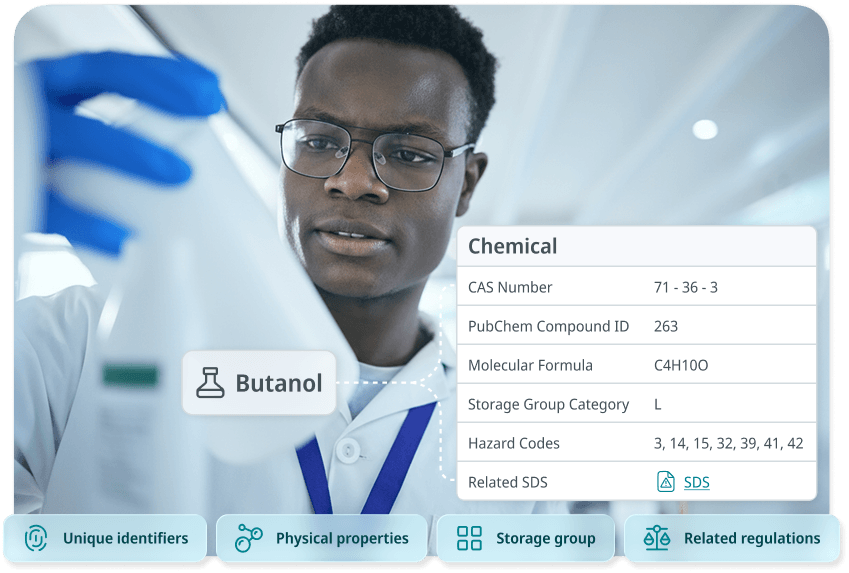
Your chemical inventory is up to date when every container has an accurate identity, location, amount, owner, hazard context, and status.
The National Academies' Prudent Practices in the Laboratory is blunt about this: an organization cannot adequately manage safety, security, emergency planning, or waste disposal without knowing what chemicals are on-site and where they are stored. It also recommends tracking inventory at the container level, with fields such as the:
- Container name,
- Formula,
- CAS number,
- Source,
- Original quantity,
- Hazard classification,
- Acquisition date,
- Storage location,
- and responsible person
A regulator may ask this as a simple question, but what they're really checking for is a living process. Can you show that new chemicals are entered promptly? Are empty, expired, abandoned, or deteriorated containers removed or archived? Can you reconcile what is in the system with what is on the shelf? Do your inventory records distinguish commercial chemicals, synthesized materials, mixtures, compressed gases, and local entries?
If your answer depends on a spreadsheet that one person updates after an annual walk-through, you're carrying unnecessary risk. A better answer sounds like this: "We track chemicals at the container level, we reconcile spaces on a defined schedule, and we can filter by room, owner, hazard class, status, and SDS availability."
2. Can first responders quickly see what is on-site?
First responders need a clear, current view of chemical names, quantities, storage methods, and locations before an emergency becomes a guessing game.
EPA's Tier II guidance shows why this matters. Covered facilities must submit annual hazardous chemical inventory information to the SERC or TERC, LEPC or TEPC, and local fire department, and Tier II information includes chemical names, maximum and average daily amounts, storage type, and location details that are useful to local planners and responders.
This is where "inventory accuracy" becomes more than an audit task. In a fire, spill, odor complaint, or unknown-container situation, someone may need to know whether a room contains water-reactive materials, oxidizers, corrosives, flammable solvents, toxic gases, or peroxide formers. The answer has to be fast enough to support action.
3. Are SDSs easy to find and tied to the right chemicals?
SDSs are inspection-ready when employees can access the right SDS for the right chemical during their work shift, including during power outages or other disruptions. OSHA says employers must maintain SDSs for all hazardous chemicals present in the workplace and make them readily accessible to workers in their work areas during shifts. Electronic SDS access is allowed, but OSHA also says there must be an adequate backup system in case the primary electronic system fails. This means workers must be trained to use the system, and hard copies must be immediately available to medical personnel in a medical emergency.
The practical inspection question is, "Can the right person find the right SDS quickly enough to use it?" That means SDSs should be searchable by chemical name, CAS number, manufacturer, and product identifier where possible. They should also be linked to inventory records so you can spot missing SDSs before an inspection does.
This matters even more as SDS data becomes more complex. A 2025 paper on SDS knowledge representation notes that the sheer number of SDSs across manufacturers and suppliers makes centralized access and data sharing challenging. You do not need to solve that whole industry problem in one day, but you do need a reliable way to connect SDSs to the chemicals your people actually use.
4. Are chemical labels complete, readable, and consistent?
Chemical labels are compliant enough for inspection when they identify the chemical, communicate the relevant hazards, remain legible, and match the SDS and inventory record.
OSHA's labeling guidance says permanent container labels must show the chemical identity and appropriate hazard warnings, and the hazard warning should give users an immediate understanding of the primary health or physical hazards. For secondary containers, OSHA explains that labels are needed when the material is not used within the same work shift, the worker who made the transfer leaves the work area, or the container moves to another area.
This is one of those inspection findings that often starts small. For example, a label gets wet or a researcher pours a solvent into a bottle and plans to label it "in a minute." A mixture sits in a flask after the person who made it leaves. A manufacturer label fades until the CAS number is barely readable. Each case makes it harder to connect the container to the SDS, storage rule, waste pathway, and emergency response plan.
For SDS and labeling workflows, a platform like SciSure is the most useful when you want to close the gap between "We probably have the right document somewhere" and "This container record, SDS, hazard data, and location are connected."
5. Are chemicals stored properly?
Chemicals are stored properly when the storage method follows hazard compatibility, quantity limits, container condition, security needs, and local fire and building code requirements.
Regulators may ask this question while looking inside a cabinet, walking through a stockroom, or reviewing a report. Prudent Practices recommends storing chemicals in designated cabinets or shelves, keeping exits and emergency equipment clear, avoiding benchtop and hood storage except for chemicals in current use, separating incompatible chemicals, and storing flammable liquids in approved flammable-liquid storage cabinets. OSHA's laboratory safety guidance also tells employers to minimize materials in the immediate work area, return unneeded materials to storage promptly, and store solvents properly in approved flammable-liquid storage cabinets.
This is also where inventory and storage have to talk to each other. If your system can show total flammable liquid quantities by control area, that helps you spot issues before a fire marshal does. If it can identify incompatible storage groups, expired peroxide formers, deteriorated containers, or abandoned chemicals, you can fix problems while they are still housekeeping and training issues rather than inspection findings.
Recent research points in the same direction. A 2025 analysis of more than a decade of chemical-industry fire investigation reports found that narrative incident data can reveal risk patterns around hazardous chemical leakage, unsafe storage practices, equipment or facility problems, and ignition conditions. That study is not a lab-specific regulation, but the lesson applies: storage problems become easier to prevent when you can see the pattern early.
Read More: The 5 Best EHS Software Platforms For Labs in 2026
What does regulator readiness look like in practice?
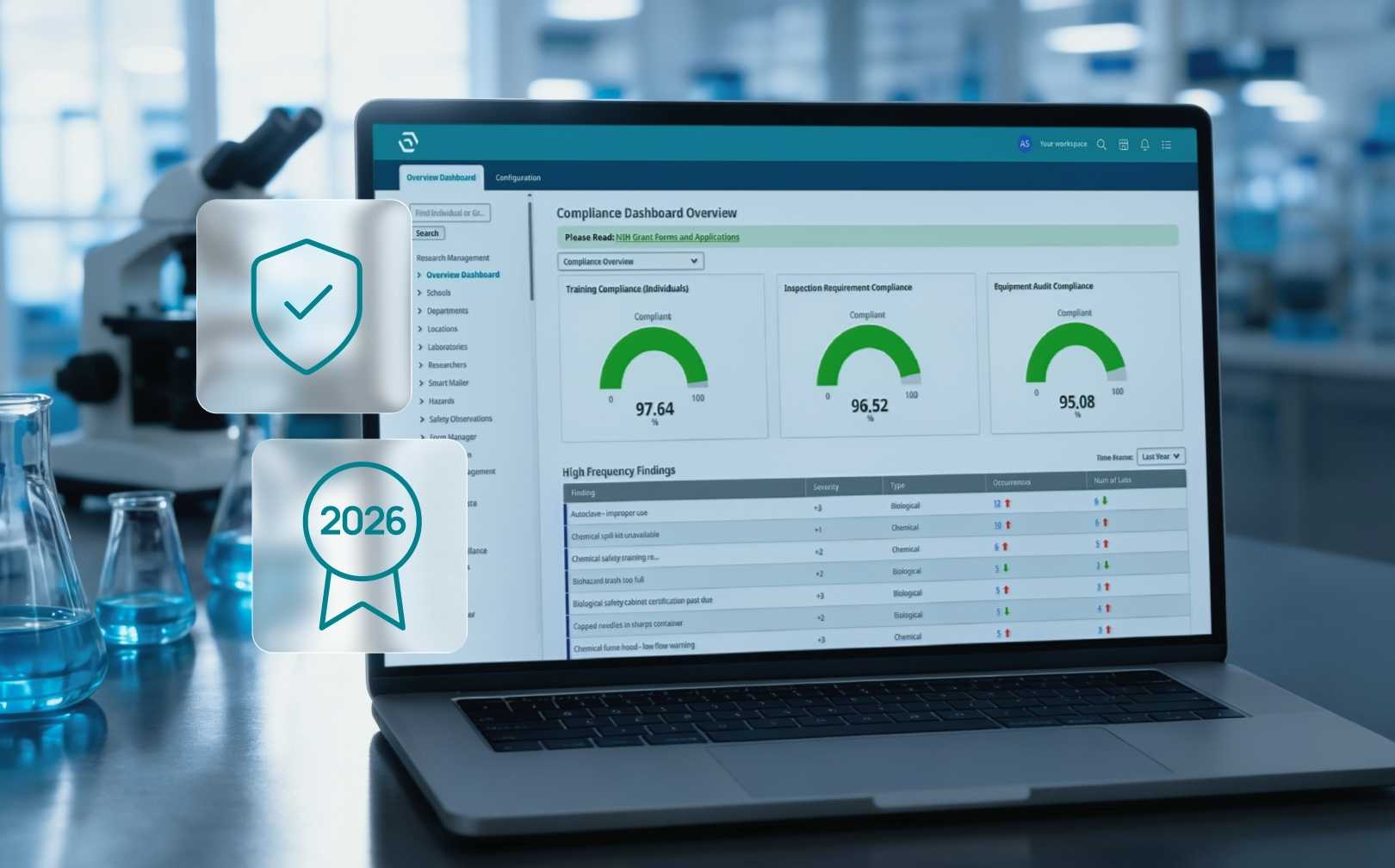
Regulator readiness looks like replacing scattered spreadsheets, paper binders, and disconnected records with searchable chemical, SDS, hazard, and training data your team can trust.
A strong example is The Engine Accelerator, a Cambridge-based tough-tech accelerator supporting resident companies across shared lab environments. Upon implementing SciSure's ChemTracker module, The Engine grew from 10 to 50 laboratory resident companies, while its Lab Operations team had to coordinate chemical inventory, permitting, and compliance across many different research programs.
Before implementation, the team relied on Excel spreadsheets, paper, and Access databases to manage complex lab operations. After adopting ChemTracker, a capability now supported under SciSure's Health & Safety solutions, The Engine improved the process of identifying hazard information for resident companies, locations, and individuals from several hours to less than five minutes. Residents could find digital SDSs instead of relying on paper binders and gain better awareness of the hazards present in their labs.
So when a regulator asks what is in a room, where a compressed gas is located, whether SDSs are accessible, or how your team knows its data is accurate, the answer should come from a system your team already uses every day.
What should you do before the next regulator visit?
Begin your prep by testing whether your team can answer the five questions quickly with records that match the lab, not just with policies that sound good on paper. Start with a short self-audit:
- Pick three rooms and confirm the physical inventory matches your system.
- Search for SDSs by chemical name, CAS number, manufacturer, and product identifier.
- Check whether secondary containers are labeled and still in the right work area.
- Review storage by hazard group, especially flammables, oxidizers, corrosives, reactives, peroxide formers, and compressed gases.
- Confirm who owns HazCom updates, chemical hygiene plan updates, employee training, inspections, and corrective actions.
- Review whether your Tier II, fire code, MAQ, or local reporting workflows use current container data.
The goal is to make your normal process strong enough that an inspection feels like showing your work. Regulators just want proof that your chemical safety program is current, connected, and usable by the people who depend on it.
If your inventory is live, your SDSs are accessible, your labels are readable, your storage decisions are documented, and your emergency response information is easy to share, you are in a much better position to answer confidently. But if those pieces live in separate binders, spreadsheets, inboxes, and institutional memory, the audit will feel harder than it needs to.
If your lab feels more like the latter, get in touch with us. Let's explore how SciSure's Health & Safety features can help you build one that's audit-ready at all times.

Read more of our blogs about modern lab management
Discover the latest in lab operations, from sample management to AI innovations, designed to enhance efficiency and drive scientific breakthroughs.