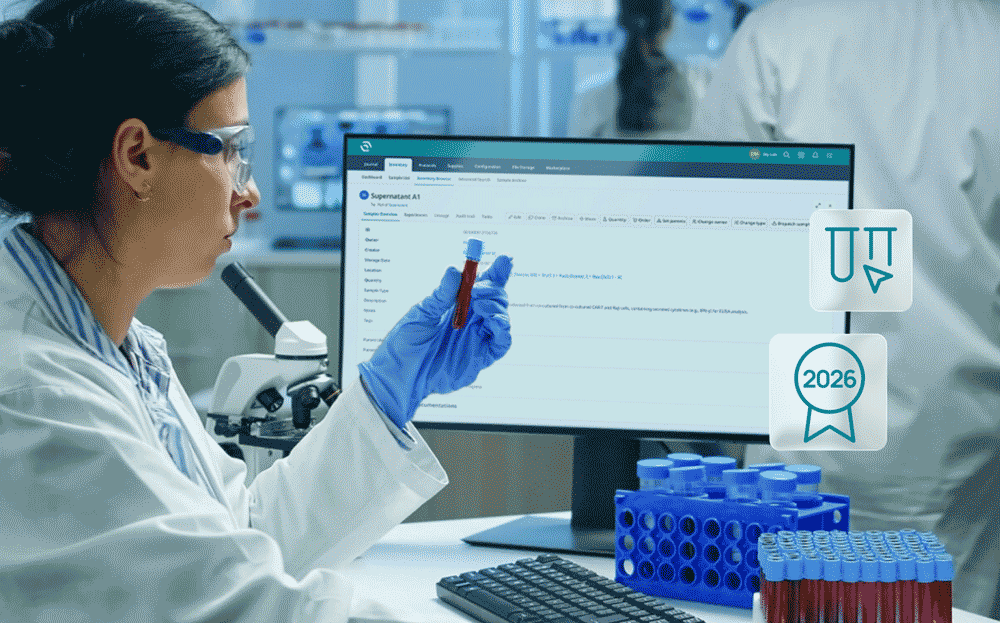
LIMS for Small Labs: What to Look For & Why It Matters
Explore how LIMS for small labs helps teams structure data, automate workflows, improve traceability, reduce manual work, and stay audit ready as they grow.
Download Whitepaper
TL;DR
- Small labs often delay adopting LIMS software, but compliance requirements like FDA 21 CFR Part 11 and GxP apply regardless of lab size.
- A LIMS built for the R&D sector manages samples, inventory, workflows, and equipment, not just storage locations.
- Key features to prioritize include sample tracking, workflow automation, audit-ready records, and ELN integration.
- Choosing a LIMS built around rigid, predefined workflows rather than flexible R&D processes is one of the costliest mistakes small labs make.
- Scalability should be a primary selection criterion from the start, because migrating to a new system later costs significantly more than choosing the right one early.
Ready to see SciSure in action?
No commitment · Free consultation
Small labs operate under real constraints: lean teams where one person covers multiple roles, no dedicated IT support, and compliance requirements that don't shrink just because the headcount does. Sample data that starts in spreadsheets quickly becomes difficult to search, audit, or hand off reliably. At a certain point, the system holding your research together becomes the thing slowing it down.
A LIMS is not an enterprise-only investment, but choosing the wrong one compounds the problem. A system built around rigid, predefined testing pipelines introduces complexity that iterative R&D teams don’t need and can’t maintain. This guide covers what one actually needs from a LIMS software for small labs, and what functionally separates a system designed for research workflows from one that wasn't.
Why small labs need a LIMS earlier than they think
The assumption that LIMS software is built for large organizations tends to hold until something goes wrong. A mislabeled sample, a failed audit, a researcher who leaves and takes institutional knowledge with them. By the time the need becomes obvious, the cost of fixing it is higher than the cost of having started earlier.
Manual tracking systems have a compounding problem. In a lean team where the same person is running experiments, managing inventory, and handling compliance documentation, gaps accumulate quietly. Spreadsheets don't enforce data entry standards, don't maintain version history, and don't generate the structured audit trails that regulatory reviewers expect. The bigger the dataset grows, the harder it becomes to retroactively impose structure on it.
Compliance requirements don't scale down with lab size. FDA 21 CFR Part 11, GxP, and institutional requirements apply based on the work being done, not the headcount. Building data structure into daily workflows from the start is significantly less disruptive than reconstructing it when an audit is scheduled.
What a LIMS actually manages in a small lab context
A Laboratory Information Management System (LIMS) is often described in terms of sample storage, but in an R&D context, that framing undersells what the system actually does.
LIMS software built for the R&D sector manages samples, inventory, workflows, equipment, and the associated data connecting them. That means tracking a sample from initial registration through lineage, storage, and disposal, maintaining accurate inventory records without manual reconciliation, and linking equipment usage to specific experiments.
It is worth distinguishing this from LIMS platforms built around rigid, predefined testing pipelines. Those systems are designed for high-throughput environments where workflows are standardized and process rigidity is itself a compliance requirement. That design works well in the right context, but it does not account for the iterative, protocol-driven work of R&D. For small teams evaluating LIMS systems for small laboratories, the category label alone does not tell you whether a system fits your type of work. A LIMS designed for research accommodates flexible workflows, variable sample types, and evolving experimental parameters — regardless of whether the work is basic research, translational, or clinical R&D.
Key features to prioritize when choosing a LIMS for a small lab
Not every LIMS feature matters equally to a small lab. The evaluation should focus on what directly reduces operational risk, supports lean workflows, and holds up as the lab grows.
Sample tracking and traceability
Sample loss in a small lab is a proportionally larger problem than in a large one. There is no redundancy to absorb it. A LIMS designed for R&D tracks samples from initial registration through lineage, transfer, and disposal using configurable metadata fields that reflect how the lab actually works. Check-out/check-in, sample dispatch with accept and deny controls, and Barcode Automation reduce manual handling for researchers already covering multiple responsibilities. When a sample's full history is recorded systematically, locating it or handing it off takes minutes rather than a manual search through notebooks and spreadsheets.
The University of Pittsburgh Behavioral Immunology Laboratory replaced a hybrid manual tracking method with sample management workflows in SciSure LIMS, using identification filters and Barcode Automation to locate and move samples without building custom layouts for each study. Lab Manager Zak Hutchinson reported a 50% improvement in the time spent tracking and managing samples.
Workflow automation for lean teams
In a small lab, one researcher often handles sample registration, inventory tracking, instrument operation, and compliance documentation within the same day. Each manual handoff between those tasks is an opportunity for error and a drain on time that should go toward analytical work.
Triggers and Automations address this directly. Sample registration can be configured to trigger automatically based on defined conditions, status notifications go out without manual follow-up, and webhook alerts route to Slack or Teams when action is required. Barcode Automation reduces inventory updates to a scan, eliminating manual data entry for reagents and consumables. When instruments are connected, data capture happens without transcription, removing one of the most common sources of error in small lab environments.
The practical outcome is that the system handles the administrative layer of lab operations consistently, without depending on a researcher to remember each step. For lean teams where capacity is the primary constraint, that reliability is what makes automation worth implementing.
Audit-ready records from day one
Small labs going through their first regulatory review frequently discover the same problem: records that made sense day-to-day were never structured for external scrutiny. Reconstructing compliant documentation from informal notes, disconnected files, and spreadsheets is time-consuming and produces results that don't hold up well under review.
A LIMS builds compliance into daily workflows rather than treating it as a separate process. Every sample registration, status change, data entry, and user action is logged automatically. Records are version-controlled, timestamped, and searchable without requiring researchers to maintain a parallel documentation system. That structure is present from the first day of use, not assembled retroactively when an audit is scheduled.
For labs operating under FDA 21 CFR Part 11, electronic records and signatures need to meet specific integrity and traceability requirements. GxP-aligned workflows require that research activities are documented in a consistent, reproducible format. SOC 2 Type II certification provides assurance around the security and availability of the systems holding that data. Small labs that choose a LIMS meeting these standards are not over-engineering their compliance posture. They are avoiding the cost of rebuilding it later.
Arctic Therapeutics centralized sample management, inventory, and quality documentation workflows in SciSure LIMS, saving two hours per week on sample and inventory management while strengthening their ISO 15189 compliance support and maintaining full traceability across samples and reagents.
ELN integration for research workflows
In many small labs, experiment documentation and sample data live in separate tools with no structured connection between them. A researcher completes work in an electronic lab notebook, then manually cross-references sample records in a spreadsheet or a disconnected system. That gap creates duplicated effort, introduces transcription errors, and makes it difficult to reconstruct the full context of a result when it matters most.
When a LIMS connects workflows with an electronic lab notebook, the research record becomes more complete and easier to maintain. Linking experiments to sample records directly means a result is traceable to the specific sample, preparation method, and reagent lot associated with it. It improves visibility across research activities without requiring researchers to maintain parallel records in multiple places. For small R&D teams where one person may be responsible for both experimental work and documentation, reducing that administrative overhead has a direct impact on how reliably records are kept.
Siloed tools also create institutional knowledge risk. When experiment context and sample data are stored separately, the connection between them often exists only in a researcher's memory. Connecting those workflows reduces that dependency and makes research records more durable over time.
Scalability without a system switch
Outgrowing a LIMS is not an easy upgrade. It means exporting and migrating research data, retraining staff on a new system, repeating LIMS validation under applicable regulatory frameworks, and managing that transition while the lab continues to operate. For a small team without dedicated IT resources, that process is disruptive in a way that is difficult to fully anticipate at the point of first adoption.
Scalable infrastructure means the system accommodates growth without requiring a platform change. Role-based access controls allow permissions to be configured precisely as teams expand and responsibilities shift. Multi-site support means the same system that works for a single lab can extend to additional locations without architectural changes. An open API ecosystem of add-ons allows the lab to connect instruments, integrate procurement systems, and extend functionality as operational complexity increases, without outgrowing the core platform.
The decision to choose an affordable LIMS system for small laboratories based primarily on upfront cost tends to defer rather than avoid the scalability problem. A system that fits today's workflows but cannot accommodate next year's headcount, compliance requirements, or operational scope will eventually need to be replaced. The cost of that replacement, in time, data integrity risk, and operational disruption, typically exceeds whatever was saved in the original selection.
What makes a LIMS right for R&D vs other lab types
Implementing a LIMS built for rigid, high-throughput pipelines in a research lab is a design mismatch, not just a feature gap, so it helps to know the types of LIMS before you shortlist.
Some LIMS platforms are built around standardized test panels and predefined workflows designed for speed and consistency across high-throughput environments. Others are designed for manufacturing contexts where process rigidity is itself a compliance requirement. Both do what they are designed for well. Neither architecture accounts for the way R&D labs actually work — including clinical R&D teams, translational research groups, and biobanks that need the flexibility to adapt workflows as research evolves.
Research workflows are iterative. Protocols change between experiments, sample types vary across projects, and inventory needs shift depending on what is being tested. A LIMS designed for the R&D sector accommodates that variability, connecting protocols to experiments, experiments to samples, and samples to equipment and inventory. When evaluating LIMS solutions for small labs, the practical question is not whether a system can track samples. Most can. The question is whether it was designed for research workflows specifically, and whether it will support that work without requiring the lab to reshape its processes around the software.
Common mistakes small labs make when choosing a LIMS
Most LIMS selection mistakes reflect the constraints small labs operate under: limited time for evaluation, pressure to keep costs down, and no dedicated IT staff to assess implementation complexity before committing.
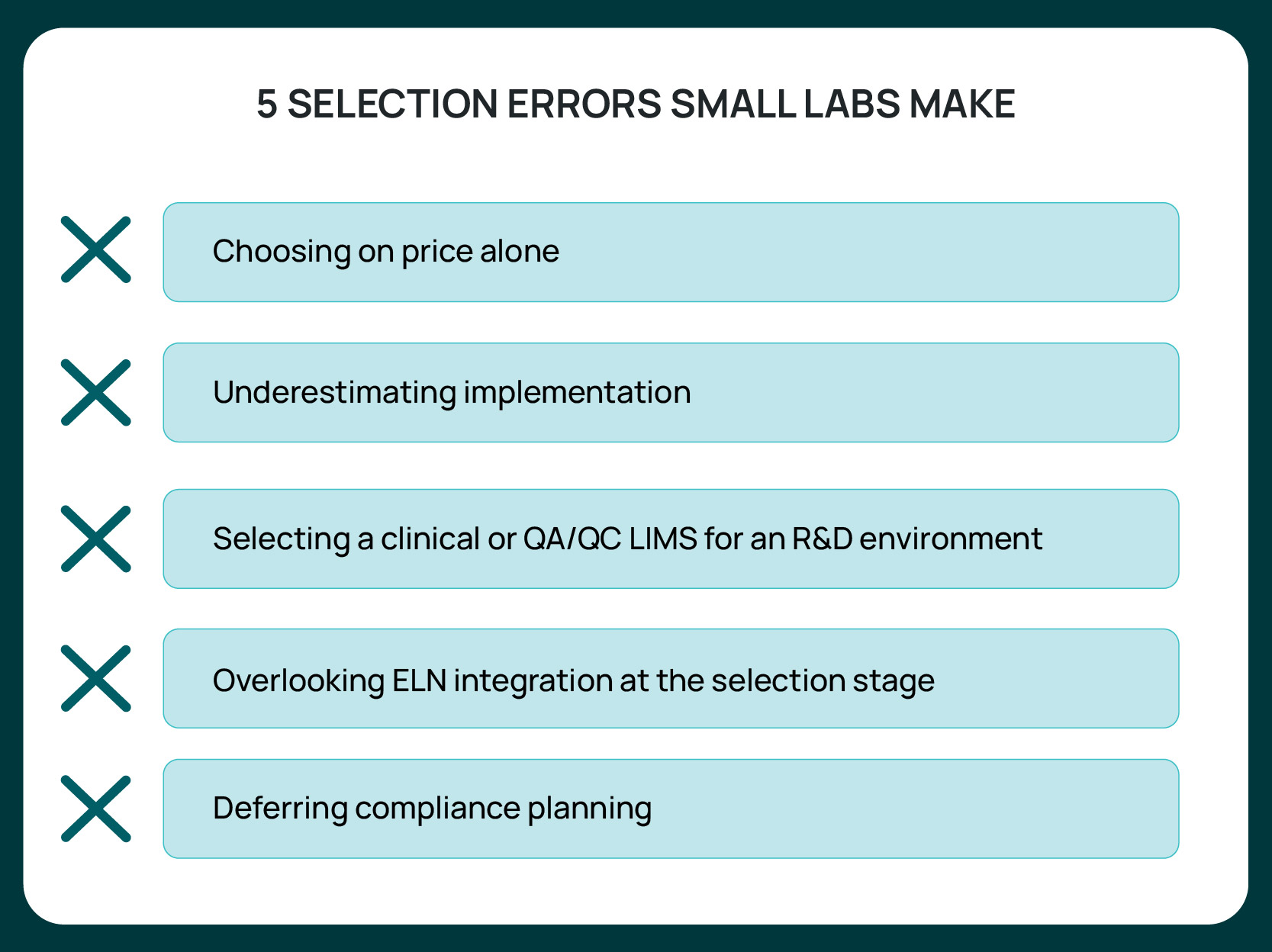
Choosing on price alone. Affordability matters, particularly for grant-funded labs, but the upfront cost of affordable LIMS for small labs rarely reflects total cost of ownership. A system that requires extensive customization, lacks adequate support, or cannot scale will generate costs that the initial comparison did not capture.
Underestimating implementation. A LIMS requires real configuration: user roles, metadata schemas, workflow structures, and data migration. Labs that treat this as a formality often find adoption stalls when researchers encounter a system that was never properly set up for their workflows.
Selecting a LIMS built for rigid, predefined pipelines and applying it to iterative R&D work. The rigidity that makes those systems effective in their intended context creates friction in iterative R&D work, and the mismatch typically becomes apparent only after implementation.
Overlooking ELN integration at the selection stage. A LIMS that cannot connect workflows with experiment documentation adds administrative overhead rather than reducing it.
Deferring compliance planning. FDA 21 CFR Part 11, GxP, and institutional requirements apply to how records are created from day one, not just when an audit is scheduled. Retrofitting a compliant data structure onto an existing system is significantly harder than choosing one that supports it from the start.
How to evaluate LIMS options as a small lab
With limited time and no dedicated IT staff, small labs need an evaluation framework that surfaces the right questions quickly.
R&D workflow fit. Does the system manage samples, inventory, equipment, and workflows in a research context, or was it built around rigid, predefined testing pipelines? This is the first filter, not an afterthought.
Implementation complexity. How much configuration is required before the system is usable? What does the vendor provide in terms of onboarding support, documentation, and setup guidance? A system that takes months to configure is a significant burden for a small team.
ELN integration capability. Can the system connect workflows with experiment documentation directly, or will the lab be managing two disconnected tools? For R&D teams, this is a core functional requirement.
Compliance certifications. Does the system support FDA 21 CFR Part 11, GxP, and SOC 2 Type II requirements? Verifying this at the selection stage is significantly easier than discovering gaps during an audit.
API and integration ecosystem. Can the system connect to instruments, procurement tools, and external platforms as the lab grows? An open integrations ecosystem reduces the risk of the platform becoming a bottleneck.
Vendor support quality. What does ongoing support look like after implementation? For small labs without internal technical resources, vendor responsiveness matters more than it might in a larger organization.
Scalability. Will the system accommodate more users, additional sites, and increased data complexity without requiring a platform migration?
SciSure LIMS is one example of a LIMS designed for the R&D sector that covers these criteria: connecting sample management with ELN workflows, supporting relevant compliance frameworks, and providing an open API and Marketplace ecosystem for extensibility.
The right LIMS grows with your lab
Small labs don't need a stripped-down LIMS. They need the right one.
The cost of choosing poorly is not abstract. It shows up as data that cannot be migrated cleanly, researchers retraining on a new system, and research continuity disrupted mid-project. For a lean team, that setback compounds the longer the wrong system stays in place.
A LIMS that fits R&D workflows brings structure to sample data from the start, connects workflows across experiments, inventory, and equipment, and scales as the lab grows in headcount, project complexity, and compliance requirements. That is a different outcome from simply having a system in place.
If you are evaluating LIMS software options for small labs, SciSure covers these criteria for R&D teams at any stage. Talk to a specialist to find out if it fits your workflows.
FAQ
Do small labs really need a LIMS?
Yes, and earlier than most expect. The assumption that LIMS is an enterprise tool leads small labs to delay adoption until manual systems have already created problems. A LIMS designed for the R&D sector suits labs at any stage. The earlier data is structured consistently, the less effort it takes to maintain traceability and support compliance as the lab grows.
What is the difference between a LIMS and a spreadsheet-based system?
Spreadsheets are flexible but passive. They don't enforce data entry standards, maintain version history, or generate audit trails. A LIMS provides structured sample records and automatic activity logging that holds up under regulatory review. In SciSure LIMS, every sample registration and status change is logged automatically, something a spreadsheet cannot replicate regardless of how carefully it is maintained.
How long does it take to implement a LIMS in a small lab?
It depends on workflow complexity and how much data needs to be migrated. A small lab with straightforward workflows can typically get operational within a few weeks. Custom metadata schemas, multiple user roles, and legacy data migration will extend that timeline. Vendor onboarding support is a meaningful factor in how quickly a small team reaches full adoption.
What features should a small lab prioritize in a LIMS?
Sample tracking with configurable metadata, workflow automation, audit-ready records, ELN integration, and scalable infrastructure are the core priorities. Compliance certifications such as FDA 21 CFR Part 11 and GxP support should be verified at the selection stage rather than assumed. SciSure covers these priorities for R&D teams at any stage.
Can a LIMS integrate with an ELN for small research teams?
Yes, and it is one of the more important capabilities to verify before selecting a system. When LIMS and ELN workflows are siloed, researchers end up maintaining parallel records across disconnected tools. SciSure connects LIMS and ELN workflows directly, linking experiments to sample records and improving visibility across research activities.
Is a cloud-based LIMS better for small labs?
For most small labs, cloud deployment removes the burden of managing on-premise infrastructure, which matters when there is no dedicated IT staff. Security remains a valid consideration regardless of deployment model. SciSure holds SOC 2 Type II and ISO 27001 certifications, providing assurance around data security and access controls.
.png)
Read more of our blogs about modern lab management
Discover the latest in lab operations, from sample management to AI innovations, designed to enhance efficiency and drive scientific breakthroughs.