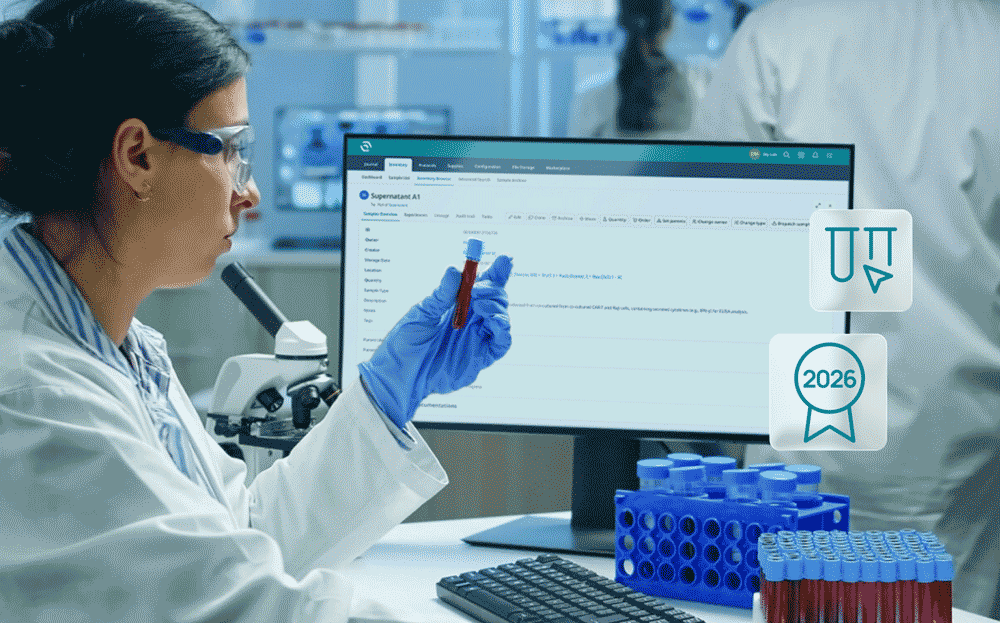
How to Build a Scalable Sample Management Strategy

Build a scalable sample management strategy with clear lifecycles, standardized metadata, unified records, and digital workflows that reduce loss and improve traceability
March 12, 2026
()
min read
Un laboratoire

Download Whitepaper

By submitting this form, you agree with our Privacy Policy.
Thank you! Download the file by clicking below:
Download
Oops! Something went wrong while submitting the form.

Table of Contents

Thank you! Your submission has been received!
Oops! Something went wrong while submitting the form.

Table of Contents

TL;DR

A scalable sample management strategy replaces informal spreadsheet tracking with structured digital workflows, ensuring traceability, reproducibility, and operational efficiency as research organizations grow.

  • Lifecycle and Metadata Foundations: Map every sample stage from accessioning through disposal to identify risk points, then standardize metadata fields like source, matrix, hazard classification, and protocol version at intake to prevent downstream failures in retrieval and audit readiness.
  • Single Digital System of Record: Consolidate fragmented data from spreadsheets, ELNs, and freezer maps into one governed platform with barcoded identifiers, real-time location visibility, and lifecycle audit trails. SciSure for Research eliminates silos that create duplicate samples at scale.
  • Lineage and Storage Architecture: Capture parent-derivative relationships and aliquot chains automatically as work happens, not manually after the fact. Pair this with hierarchical storage organized by room, freezer, shelf, rack, box, and position with enforced placement rules.
  • Automated Handoffs and Access Control: Replace manual logging of transfers and consumption tracking with barcode-driven updates and triggered alerts. Layer role-based permissions so only authorized users can relocate samples or perform disposal, with every interaction generating an audit record.
  • Retrieval and Reuse Strategy: Enable instant sample discovery through searchable metadata, barcoded storage hierarchies, real-time availability tracking, and experimental history links. Predictable retrieval reduces rework, prevents unnecessary sample recreation, and transforms archives into reusable research assets.

As research organizations grow, operational friction grows faster than most teams expect. No process absorbs more of that strain than sample management – the quiet but critical layer of infrastructure that keeps your experiments connected, traceable, and reproducible.

When teams are small, informal practices can work well enough: shared spreadsheets, handwritten labels, mental maps of where things live in the freezer. But these habits don’t scale. As sample volumes rise and more people interact with them, gaps emerge. Metadata drifts, storage becomes inconsistent, handoffs get missed, and lineage becomes harder to reconstruct. These issues seem minor in the moment but compound quickly, affecting turnaround time, reproducibility, and confidence in results.

A scalable sample management strategy addresses this by creating a consistent, end-to-end approach for how samples are created, annotated, moved, stored, and reused across the lab. It provides the digital structure and operational clarity needed to keep sample workflows predictable as research expands, enabling teams to work faster, avoid loss, and maintain high-quality data as complexity grows.

This guide outlines the practical steps research teams can take to build a sample management strategy that not only works today, but continues to scale cleanly as operations expand and workflows evolve.

Step 1: Define the lifecycle you need to manage

Before improving sample management, you need absolute clarity on the lifecycle your samples move through.

Start by mapping every stage a sample passes through, from the moment it enters the lab to its eventual retirement. For most organizations, this includes accessioning, labeling, metadata capture, aliquoting, transfers between people and instruments, storage, retrieval, experimental use, and disposal. The goal isn’t to create a perfect process map, but to understand where variation exists today and where operational risk tends to cluster.

This exercise also clarifies the sample types you need to manage (biological specimens, clinical samples, research-specific types) and the level of context required for each. As complexity grows, differences in sample states, containers, hazards, and ownership become meaningful, and documenting them consistently becomes essential.

By defining the sample lifecycle upfront, you create a foundation for every later decision: what metadata to standardize, how to design storage hierarchies, where automation makes sense, and which digital systems should anchor the workflow.

Step 2: Standardize metadata as soon as possible

Once the lifecycle is defined, the next step in scalable sample management is ensuring every sample enters the system with complete, consistent metadata. Most downstream problems (misplaced samples, broken lineage, slow retrieval, failed audits) can be traced back to incomplete or inconsistent information captured at the start.

Begin by defining the required fields for each sample type. Depending on your workflows, this may include source, matrix, collection details, hazards, protocol version, owner, container type, and any domain-specific attributes that influence how the sample should be handled. The aim is not to document everything, but to document the right things – the data that will matter later for storage, routing, analysis, and compliance.

Standardization is key. If different teams record different fields, or use different terminology for the same information, metadata quickly becomes non-functional. A reliable digital record hinges on shared structure.

This step lays the groundwork for eliminating manual searching, improving chain-of-custody, and enabling automated routing or retrieval later.

Step 3: Establish a single digital system of record

Even with well-defined lifecycles and standardized metadata, sample management will break down if information is scattered across tools. Spreadsheets, ELNs, freezer maps, instrument software, and ad-hoc notes all capture pieces of the truth, but none capture the whole. As the organization scales, this fragmentation creates blind spots: duplicate samples, inconsistent naming, incomplete lineage, and difficulty reconstructing who handled what, when, and why.

A scalable sample management strategy depends on a single digital system of record—one governed source where every sample’s metadata, storage location, movement history, and experimental usage converge.

The system of record should support:

• Barcoded identifiers

• Full sample lifecycle audit trails

• Consistent naming and categorization

• Real-time visibility into status and location

• Structured storage hierarchies

• Links between samples, derivatives, and experiments

SciSure for Research was built around this principle: creating a single governed sample backbone that eliminates information silos and reduces the operational friction that grows with scale.

A unified digital record becomes the foundation for everything that follows: automation, lineage, compliance, and efficient retrieval all depend on it.

SciSure Research
See how a unified sample record works in practice
Barcoded tracking, real-time location visibility, and full lifecycle audit trails — get a walkthrough tailored to your lab.
Request a demo

Step 4: Build lineage into the workflow (not as an afterthought)

As research scales, the ability to understand where a sample came from, how it was created, and how it has been used becomes just as important as the sample itself. Yet in many labs, lineage is treated as optional, tracked inconsistently, recorded after the fact, or left to the memory of the people who handled the work.

A scalable sample management strategy requires lineage to be designed directly into the workflow, not layered on top of it.

Start by defining the relationships that matter in your research environment:

• Parent samples and their derivatives

• Aliquots and sub-aliquots

• How samples are consumed or partially used

• Which experiments they support

• How often they’re reused or referenced downstream

These relationships form the backbone of reproducibility. Without them, teams struggle to reconstruct results, validate findings, or understand how experimental context influences outcomes.

To make lineage reliable, it must be captured automatically as work happens, not manually at the end of a workflow. Every transfer, aliquoting step, or experimental action should update the sample’s digital history. When lineage is baked into everyday processes, labs eliminate the guesswork around provenance, reduce repeated work, and maintain a consistent scientific narrative even as staff and projects change.

Step 5: Design storage architecture that scales

Storage is where most sample management strategies start to crack under pressure. What feels manageable with a few freezers becomes chaotic as volumes rise, teams grow, and new sample types enter the workflow.

A scalable storage strategy requires a clear, hierarchical structure that defines how samples move from general to specific locations. In most labs, this means mapping storage as a nested series of containers: room → freezer → shelf → rack → box → position. The key is to make these hierarchies explicit, consistent, and easy to navigate digitally.

To keep the system resilient as complexity grows, define rules for:

• Which containers or sample types are allowed in which locations

• How much capacity each level can hold

• How new storage units are added without disrupting existing organization

• How to prevent mis-slotting or ad-hoc “temporary” placements

SciSure for Research supports this by allowing teams to model storage hierarchies directly in the system, enforce container logic, and update locations in real time as samples move. When every change is captured instantly, retrieval becomes predictable, audits become simpler, and storage never becomes the bottleneck as operations scale.

Step 6: Automate movement and high-risk handoffs

Even with clear lifecycles and well-structured storage, sample management can still break down at the moments where people and processes intersect. Transfers between scientists, instrument handoffs, aliquoting steps, and freezer interactions are frequent, fast-moving, and easy to miss if updates rely on manual entry.

A scalable strategy reduces this risk by automating the steps most prone to error.

Start by identifying actions that currently depend on memory, notes, or transcription. Common examples include assigning storage positions, updating freezer locations, logging transfers, recording thaw–refreeze events, or capturing how much of a sample was consumed. These details matter for chain-of-custody and reproducibility – and they’re typically the first to be forgotten under time pressure.

Automation can support these high-risk steps through:

• Barcode-driven movement updates

• Automatic storage assignment based on sample type or hazard rules

• Triggered tasks when a sample changes state, location, or owner

• Alerts for time-sensitive or temperature-sensitive materials

• Workflow steps that only progress once required metadata is captured

This is where modern digital platforms make a difference. In SciSure for Research, every movement is logged automatically with timestamp and user information, ensuring chain-of-custody stays intact without relying on manual bookkeeping. The system captures the operational reality as it happens, rather than depending on teams to update records after the fact.

SciSure Research
Automate chain-of-custody without changing how your team works
Barcode-driven movement logging, triggered alerts, and automatic audit trails — see how it fits into your existing workflows.
Request a demo

Step 7: Govern access and permissions with precision

As sample volumes grow and more people interact with them, access control becomes a critical part of scalable sample management. What works in a small team: shared visibility, informal ownership, broad editing rights, quickly becomes risky at scale. Sensitive materials, hazardous samples, and regulated workflows all require clearer boundaries around who can see, modify, move, or retire a sample.

A scalable approach defines role-based permissions that align with scientific responsibilities and compliance requirements. This includes controlling who can update metadata, relocate samples, alter storage assignments, or perform disposal actions. It also ensures every interaction leaves a traceable record.

SciSure for Research supports this by enforcing governed access across the entire sample lifecycle. Users only see and edit what they’re responsible for, while audit trails capture every change automatically. The result is a more secure, predictable workflow where accountability is built into everyday operations – not added on top.

Step 8: Build a retrieval and reuse strategy

Reliable retrieval is one of the clearest indicators of scalable sample management. When teams can’t quickly find what they need, experiments stall, duplicate samples are created, and confidence in the system erodes. As volumes grow, retrieval becomes less about memory and more about whether the underlying data and structure make samples discoverable.

A scalable strategy ensures samples can be located instantly and unambiguously, supported by consistent metadata, barcoded storage hierarchies, and a digital record that accurately mirrors the physical environment. It also requires clear status tracking (active, partially used, exhausted, or retired) so teams don’t waste time searching for samples that are no longer available.

To make retrieval and reuse effortless, ensure your system supports:

• Search across metadata fields (protocol, hazard, owner, project, sample type)

• Barcoded locations tied to hierarchical storage

• Real-time availability so users know whether a sample is usable

• Links to experimental history to surface context before reuse

• Batch retrieval for pulling related samples together

• Visibility across teams, with permissions applied appropriately

When retrieval is predictable, labs reduce rework, prevent unnecessary remakes, and turn their sample archive into an asset that reliably supports future experiments.

SciSure Research
Turn your sample archive into a searchable, reusable asset
Instant retrieval, complete lineage, and governed access across teams — see how SciSure brings it all together.
Talk to a Specialist

Build the foundation before you need it

As research organizations grow, sample management shifts from a routine task to core scientific infrastructure. Informal practices that work in small teams quickly become fragile under higher volumes, more users, and diversified workflows. Scalability comes from structure: clear lifecycles, standardized metadata, a unified digital record, governed access, and workflows where movement, lineage, and retrieval happen reliably every time.

By laying these foundations early, labs can accelerate the journey from bench to bedside, achieve proof of concept faster, and ensure their work is reproducible—all for the benefit of our patients who are counting on us.

Want to explore how SciSure could help you build a resilient, scalable sample management strategy that lasts? Talk to a Specialist.

Ready to see SciSure in action?

Get a personalized demo and see how SciSure fits your lab's workflows.
Request demo

No commitment · Free consultation

As research organizations grow, operational friction grows faster than most teams expect. No process absorbs more of that strain than sample management – the quiet but critical layer of infrastructure that keeps your experiments connected, traceable, and reproducible.

When teams are small, informal practices can work well enough: shared spreadsheets, handwritten labels, mental maps of where things live in the freezer. But these habits don’t scale. As sample volumes rise and more people interact with them, gaps emerge. Metadata drifts, storage becomes inconsistent, handoffs get missed, and lineage becomes harder to reconstruct. These issues seem minor in the moment but compound quickly, affecting turnaround time, reproducibility, and confidence in results.

A scalable sample management strategy addresses this by creating a consistent, end-to-end approach for how samples are created, annotated, moved, stored, and reused across the lab. It provides the digital structure and operational clarity needed to keep sample workflows predictable as research expands, enabling teams to work faster, avoid loss, and maintain high-quality data as complexity grows.

This guide outlines the practical steps research teams can take to build a sample management strategy that not only works today, but continues to scale cleanly as operations expand and workflows evolve.

Step 1: Define the lifecycle you need to manage

Before improving sample management, you need absolute clarity on the lifecycle your samples move through.

Start by mapping every stage a sample passes through, from the moment it enters the lab to its eventual retirement. For most organizations, this includes accessioning, labeling, metadata capture, aliquoting, transfers between people and instruments, storage, retrieval, experimental use, and disposal. The goal isn’t to create a perfect process map, but to understand where variation exists today and where operational risk tends to cluster.

This exercise also clarifies the sample types you need to manage (biological specimens, clinical samples, research-specific types) and the level of context required for each. As complexity grows, differences in sample states, containers, hazards, and ownership become meaningful, and documenting them consistently becomes essential.

By defining the sample lifecycle upfront, you create a foundation for every later decision: what metadata to standardize, how to design storage hierarchies, where automation makes sense, and which digital systems should anchor the workflow.

Step 2: Standardize metadata as soon as possible

Once the lifecycle is defined, the next step in scalable sample management is ensuring every sample enters the system with complete, consistent metadata. Most downstream problems (misplaced samples, broken lineage, slow retrieval, failed audits) can be traced back to incomplete or inconsistent information captured at the start.

Begin by defining the required fields for each sample type. Depending on your workflows, this may include source, matrix, collection details, hazards, protocol version, owner, container type, and any domain-specific attributes that influence how the sample should be handled. The aim is not to document everything, but to document the right things – the data that will matter later for storage, routing, analysis, and compliance.

Standardization is key. If different teams record different fields, or use different terminology for the same information, metadata quickly becomes non-functional. A reliable digital record hinges on shared structure.

This step lays the groundwork for eliminating manual searching, improving chain-of-custody, and enabling automated routing or retrieval later.

Step 3: Establish a single digital system of record

Even with well-defined lifecycles and standardized metadata, sample management will break down if information is scattered across tools. Spreadsheets, ELNs, freezer maps, instrument software, and ad-hoc notes all capture pieces of the truth, but none capture the whole. As the organization scales, this fragmentation creates blind spots: duplicate samples, inconsistent naming, incomplete lineage, and difficulty reconstructing who handled what, when, and why.

A scalable sample management strategy depends on a single digital system of record—one governed source where every sample’s metadata, storage location, movement history, and experimental usage converge.

The system of record should support:

• Barcoded identifiers

• Full sample lifecycle audit trails

• Consistent naming and categorization

• Real-time visibility into status and location

• Structured storage hierarchies

• Links between samples, derivatives, and experiments

SciSure for Research was built around this principle: creating a single governed sample backbone that eliminates information silos and reduces the operational friction that grows with scale.

A unified digital record becomes the foundation for everything that follows: automation, lineage, compliance, and efficient retrieval all depend on it.

SciSure Research
See how a unified sample record works in practice
Barcoded tracking, real-time location visibility, and full lifecycle audit trails — get a walkthrough tailored to your lab.
Request a demo

Step 4: Build lineage into the workflow (not as an afterthought)

As research scales, the ability to understand where a sample came from, how it was created, and how it has been used becomes just as important as the sample itself. Yet in many labs, lineage is treated as optional, tracked inconsistently, recorded after the fact, or left to the memory of the people who handled the work.

A scalable sample management strategy requires lineage to be designed directly into the workflow, not layered on top of it.

Start by defining the relationships that matter in your research environment:

• Parent samples and their derivatives

• Aliquots and sub-aliquots

• How samples are consumed or partially used

• Which experiments they support

• How often they’re reused or referenced downstream

These relationships form the backbone of reproducibility. Without them, teams struggle to reconstruct results, validate findings, or understand how experimental context influences outcomes.

To make lineage reliable, it must be captured automatically as work happens, not manually at the end of a workflow. Every transfer, aliquoting step, or experimental action should update the sample’s digital history. When lineage is baked into everyday processes, labs eliminate the guesswork around provenance, reduce repeated work, and maintain a consistent scientific narrative even as staff and projects change.

Step 5: Design storage architecture that scales

Storage is where most sample management strategies start to crack under pressure. What feels manageable with a few freezers becomes chaotic as volumes rise, teams grow, and new sample types enter the workflow.

A scalable storage strategy requires a clear, hierarchical structure that defines how samples move from general to specific locations. In most labs, this means mapping storage as a nested series of containers: room → freezer → shelf → rack → box → position. The key is to make these hierarchies explicit, consistent, and easy to navigate digitally.

To keep the system resilient as complexity grows, define rules for:

• Which containers or sample types are allowed in which locations

• How much capacity each level can hold

• How new storage units are added without disrupting existing organization

• How to prevent mis-slotting or ad-hoc “temporary” placements

SciSure for Research supports this by allowing teams to model storage hierarchies directly in the system, enforce container logic, and update locations in real time as samples move. When every change is captured instantly, retrieval becomes predictable, audits become simpler, and storage never becomes the bottleneck as operations scale.

Step 6: Automate movement and high-risk handoffs

Even with clear lifecycles and well-structured storage, sample management can still break down at the moments where people and processes intersect. Transfers between scientists, instrument handoffs, aliquoting steps, and freezer interactions are frequent, fast-moving, and easy to miss if updates rely on manual entry.

A scalable strategy reduces this risk by automating the steps most prone to error.

Start by identifying actions that currently depend on memory, notes, or transcription. Common examples include assigning storage positions, updating freezer locations, logging transfers, recording thaw–refreeze events, or capturing how much of a sample was consumed. These details matter for chain-of-custody and reproducibility – and they’re typically the first to be forgotten under time pressure.

Automation can support these high-risk steps through:

• Barcode-driven movement updates

• Automatic storage assignment based on sample type or hazard rules

• Triggered tasks when a sample changes state, location, or owner

• Alerts for time-sensitive or temperature-sensitive materials

• Workflow steps that only progress once required metadata is captured

This is where modern digital platforms make a difference. In SciSure for Research, every movement is logged automatically with timestamp and user information, ensuring chain-of-custody stays intact without relying on manual bookkeeping. The system captures the operational reality as it happens, rather than depending on teams to update records after the fact.

SciSure Research
Automate chain-of-custody without changing how your team works
Barcode-driven movement logging, triggered alerts, and automatic audit trails — see how it fits into your existing workflows.
Request a demo

Step 7: Govern access and permissions with precision

As sample volumes grow and more people interact with them, access control becomes a critical part of scalable sample management. What works in a small team: shared visibility, informal ownership, broad editing rights, quickly becomes risky at scale. Sensitive materials, hazardous samples, and regulated workflows all require clearer boundaries around who can see, modify, move, or retire a sample.

A scalable approach defines role-based permissions that align with scientific responsibilities and compliance requirements. This includes controlling who can update metadata, relocate samples, alter storage assignments, or perform disposal actions. It also ensures every interaction leaves a traceable record.

SciSure for Research supports this by enforcing governed access across the entire sample lifecycle. Users only see and edit what they’re responsible for, while audit trails capture every change automatically. The result is a more secure, predictable workflow where accountability is built into everyday operations – not added on top.

Step 8: Build a retrieval and reuse strategy

Reliable retrieval is one of the clearest indicators of scalable sample management. When teams can’t quickly find what they need, experiments stall, duplicate samples are created, and confidence in the system erodes. As volumes grow, retrieval becomes less about memory and more about whether the underlying data and structure make samples discoverable.

A scalable strategy ensures samples can be located instantly and unambiguously, supported by consistent metadata, barcoded storage hierarchies, and a digital record that accurately mirrors the physical environment. It also requires clear status tracking (active, partially used, exhausted, or retired) so teams don’t waste time searching for samples that are no longer available.

To make retrieval and reuse effortless, ensure your system supports:

• Search across metadata fields (protocol, hazard, owner, project, sample type)

• Barcoded locations tied to hierarchical storage

• Real-time availability so users know whether a sample is usable

• Links to experimental history to surface context before reuse

• Batch retrieval for pulling related samples together

• Visibility across teams, with permissions applied appropriately

When retrieval is predictable, labs reduce rework, prevent unnecessary remakes, and turn their sample archive into an asset that reliably supports future experiments.

SciSure Research
Turn your sample archive into a searchable, reusable asset
Instant retrieval, complete lineage, and governed access across teams — see how SciSure brings it all together.
Talk to a Specialist

Build the foundation before you need it

As research organizations grow, sample management shifts from a routine task to core scientific infrastructure. Informal practices that work in small teams quickly become fragile under higher volumes, more users, and diversified workflows. Scalability comes from structure: clear lifecycles, standardized metadata, a unified digital record, governed access, and workflows where movement, lineage, and retrieval happen reliably every time.

By laying these foundations early, labs can accelerate the journey from bench to bedside, achieve proof of concept faster, and ensure their work is reproducible—all for the benefit of our patients who are counting on us.

Want to explore how SciSure could help you build a resilient, scalable sample management strategy that lasts? Talk to a Specialist.

About the author:

Jon Zibell

Jon Zibell is Vice President of Global Alliances & Marketing at SciSure, where he leads strategic partnerships with organizations like The Engine (MIT), US Lab Partners, and My Green Lab to help life science and research institutions modernize lab operations. He writes about the operational, safety, and technology challenges facing modern scientific organizations. Jon holds a B.S. in Marketing & Corporate Communications from Bentley University.

See all posts from this author

Inscrivez-vous à notre newsletter

Recevez les derniers conseils, articles et contenus exclusifs sur la gestion moderne des laboratoires dans votre boîte de réception.
Merci ! Votre candidature a été reçue !
Please check your email to verify your submission.
Oups ! Une erreur s'est produite lors de l'envoi du formulaire.