Lab Sample Tracking: A Practical Guide for Research Labs

Learn how lab sample tracking works, which systems support it, and how a LIMS brings structure to tracking across studies, storage locations, and teams.

July 17, 2026
()
min read
Un laboratoire

Download Whitepaper

By submitting this form, you agree with our Privacy Policy.
Thank you! Download the file by clicking below:
Download
Oops! Something went wrong while submitting the form.

Table of Contents

Thank you! Your submission has been received!
Oops! Something went wrong while submitting the form.

Table of Contents

TL;DR

  • Lab sample tracking is the process of monitoring sample location, status, and history throughout a study, from intake and storage through transfer, use, and archiving.
  • Manual tracking methods like paper logs and spreadsheets introduce risk as sample volumes grow: mislabeling, retrieval delays, and traceability gaps all become harder to manage at scale.
  • Lab sample tracking systems range from basic barcode setups to fully integrated LIMS platforms that connect sample records to experiments, protocols, and audit trails.
  • A LIMS designed for R&D tracks samples in the context of the research that generated them, not just as inventory items, giving your team structured traceability rather than a simple location log.
  • With SciSure, teams can track sample location, status, and lineage across studies and storage environments, with configurable fields, barcode automation, and audit trails where supported.

Introduction

Research labs manage samples across multiple studies, locations, and team members simultaneously. When lab sample tracking breaks down, the consequences are immediate and compound quickly: samples get misplaced, work gets repeated, traceability gaps appear in the record, and compliance exposure follows.

The risks are not hypothetical. A single mislabeled vial or unrecorded transfer can invalidate results, delay projects, and create audit failures that are difficult to recover from. If your lab relies on manual methods, like handwritten labels, paper logs, or disconnected spreadsheets, face these risks routinely.

Digital tools have changed what is possible in sample tracking. Laboratory Information Management Systems (LIMS) and integrated platforms now give labs real-time visibility into sample location, status, and history, directly connected to the experiments and protocols that generated them. SciSure supports this kind of structured, traceable sample management across research teams and storage environments.

This guide covers what sample tracking is, the types of systems available, practical steps for improving your lab's approach, and how other labs have put better tracking into practice.

What is sample tracking?

Sample tracking is the process of monitoring the location and status of samples throughout their lifecycle in the lab. It is vital for ensuring research accuracy, integrity, and reproducibility. Effective sample tracking prevents errors, minimizes sample loss, and improves data retrieval efficiency.

Traditionally, sample tracking has relied heavily on manual processes. These methods often involve handwritten labels, logs, and spreadsheets, which are prone to human error, mislabeling, and data retrieval inefficiencies. Such systems can lead to significant challenges, including misplaced samples and elongated search times, which can greatly hinder research progress.

Accurate sample tracking helps labs maintain reliable, traceable research records. Inaccurate tracking can lead to lost samples, wasted resources, and compromised research outcomes. For instance, a single misplaced sample can delay an entire project, leading to increased costs and wasted labor. If your lab relies on manual sample tracking methods often face recurring issues such as misplaced samples, data errors, and prolonged retrieval times. These delays also increase the risk of sample degradation.

These challenges highlight the need for a sample tracking system that can support consistent labeling, searchable records, and traceability as sample volumes grow.

Types of lab sample tracking systems 

Choosing the right lab sample tracking system depends on your lab's scale, regulatory requirements, and how tightly sample data needs to connect to research records. The categories below cover what is in use across research labs today, from basic manual methods to integrated research platforms.

Five ways labs track samples

Manual and paper-based systems

Logbooks, spreadsheets, and handwritten labels are still common in smaller labs or early-stage research. They require no setup and are easy to start with, but they introduce risk at scale. Data entry errors, missing records, and inconsistent labeling practices become harder to manage as sample volumes and team sizes grow.

Barcode-based tracking systems

Barcodes assign a unique identifier to each sample, which can be scanned at intake, transfer, and storage. This reduces transcription errors and creates a digital record of each interaction. Most barcode systems integrate with broader laboratory sample management software to maintain an accurate, searchable inventory.

RFID tracking systems

RFID tags can identify items without direct line of sight and may support faster bulk reads in compatible high-volume or automated storage environments. Hardware, tag performance, and software compatibility vary across systems, so labs should confirm that a given platform supports RFID for their intended sample types and storage conditions. RFID-based workflows are available in some lab management platforms for specific use cases, including chemical inventory management.

LIMS-based tracking

LIMS software designed for R&D tracks samples in the context of experiments, not just as inventory items. This means location, status, and lineage are recorded alongside the studies and protocols they belong to, giving labs structured traceability rather than a simple location log.

Integrated platforms

When sample tracking connects directly to ELN records, protocols, and audit trails, labs gain wider context for each sample action. SciSure’s Sample Dispatch feature lets users send samples between groups within the same organization. The receiving group can accept or deny the samples, and dispatch events are logged with user and timestamp information. Samples linked to experiments must be unlinked before they can be dispatched.

Separately, the free Sample Check-out Marketplace add-on adds check-out and check-in functionality and records the user and timing in the sample audit trail. Availability of these capabilities can depend on deployment version, permissions, and Marketplace configuration.

SciSure LIMS
See how SciSure handles sample tracking
Get a walkthrough of how SciSure tracks sample location, status, and lineage across studies and storage locations.
Request a demo

Transforming sample tracking with digital tools

Digital tools, especially those with LIMS capabilities designed for the R&D sector, give labs a more structured way to manage sample records, locations, and related research data.

Automation and precision

Digital tools can reduce transcription and make sample records easier to identify and update. SciSure automatically generates a unique barcode for every sample. Labs can also link an existing external barcode when working with pre-labeled samples, while supported label-printing add-ons allow teams to print 2D barcode labels. Scanning a sample barcode opens the associated sample record.

The separate Barcode Automation Marketplace add-on generates action barcodes for defined sample operations, such as changing quantities, updating sample fields, or archiving samples. Triggers & Automations can respond to events such as sample creation, archiving, field or location changes, and approaching expiration dates. Supported actions include sending an email, posting a webhook, or creating a task.

SciSure’s API and SDK can also support custom integrations and extensions, but these workflows require appropriate configuration or development.

Integration benefits

The ability to connect sample records with other lab systems is an important feature to look for in a LIMS. In research environments, sample data is most useful when it can be viewed alongside the experiments, protocols, and results it supports.

SciSure connects ELN and LIMS capabilities so teams can link sample data to experimental entries and maintain research context around each sample. This helps teams manage sample records, related study information, and storage details in one structured workflow. For labs evaluating laboratory sample tracking options, this connection can make it easier to follow samples across different stages of research without relying on disconnected spreadsheets or informal updates.  

Data security and compliance

Data security and compliance are critical considerations in sample tracking. SciSure provides role-based permissions and chronological sample audit trails that show who changed sample information, when the change was made, and what data was modified. Sample records can also be linked to experiments and storage locations to preserve their research context.

These capabilities support data integrity, audit readiness, and use in regulated environments; they do not make a lab compliant by themselves. Compliance also depends on the lab’s system configuration, SOPs, training, access controls, validation, and intended use.

Implementing effective sample tracking: Practical tips

A sample tracking system works best when it reflects how the lab already handles intake, storage, transfers, and retrieval. Before choosing new tools, review where sample data is created, where it breaks down, and which steps need stronger traceability.
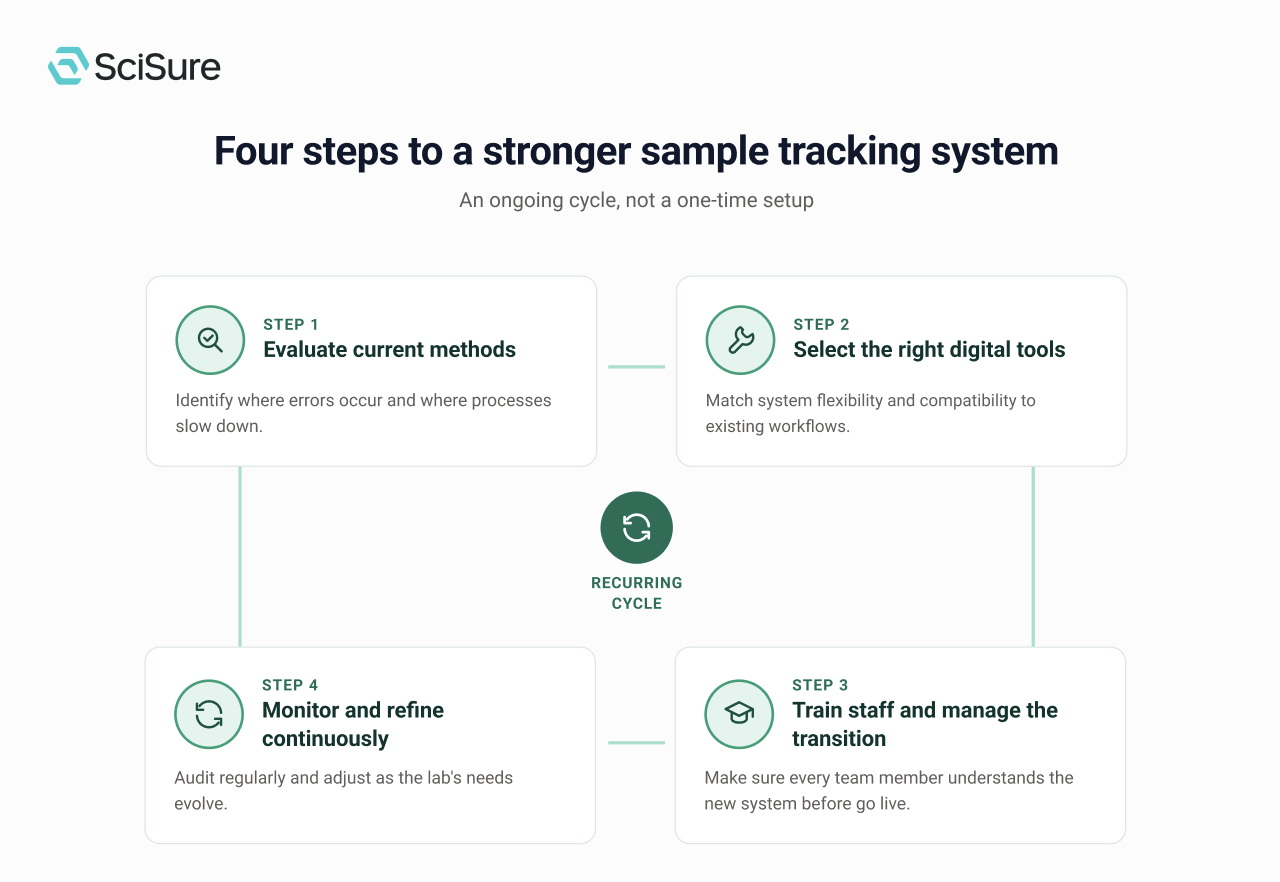
Four steps to a strong sample tracking system
Four steps to a stronger sample tracking system

Evaluate current methods

Evaluating your current sample tracking methods is the first step to improving them. Before transitioning to digital tools, assessing your current systems helps identify areas for improvement. Identify areas where errors occur or processes slow down. For example, look for inefficiencies such as manual data entry and lack of integration with other systems. This evaluation will help define what your lab needs from a sample tracking process, including where digital tools could reduce manual work, improve traceability, or support more consistent records.

Selecting the right digital tools

Consider the system's flexibility, ease of use, and compatibility with existing workflows. The right tool should support your sample types, storage needs, and reporting requirements without adding unnecessary complexity.

SciSure supports configurable sample tracking through custom fields, storage hierarchies, advanced search and filtering, experiment links, lineage, and audit trails. Optional or deployment-dependent capabilities include Barcode Automation, Sample Check-out, and Sample Dispatch, so labs should confirm which add-ons and features are available for their environment.

Staff training and transition management

Staff training and transition management are essential for successfully implementing a new sample tracking system. Ensuring that all lab personnel are trained on the new system and understand how it fits into daily lab work will ease the transition. This will help staff to understand the benefits, flag any concerns, and improve overall efficiency. Managing the transition to digital systems smoothly can minimize disruptions and ensure that your lab continues to operate efficiently. Ongoing support and resources should be available to address any challenges that arise during the transition.

Continuous monitoring and enhancement

Continuous monitoring and refinement of sample tracking practices are vital for long-term success as your lab's needs evolve. Regular audits and feedback sessions can help identify areas for improvement and critically evaluate your sample tracking processes. This ongoing evaluation helps identify potential issues before they become significant problems. Making necessary adjustments to improve efficiency and accuracy ensures the system remains effective over time.

Success stories in action

These customer stories show how structured sample tracking can reduce manual work and improve visibility in real lab environments. The examples below focus on labs that moved away from paper records, spreadsheets, or time consuming retrieval processes toward more organized digital sample management.

University of Pittsburgh Behavioral Immunology Lab

The University of Pittsburgh Behavioral Immunology Lab reports a 50% improvement in the time spent tracking and managing samples with SciSure. Previously, the lab relied on paper records and Excel spreadsheets, making it difficult to track sample locations, quantities, and remaining inventory.

With SciSure, researchers can search by sample ID, view the freezer, shelf, cryo box, and position where a sample is stored, and update its physical and digital location together. The lab also uses Barcode Automation for ELISA kit inventory and standardized label printing. Read the full story.

Lund University Department of Translational Medicine

Lund University’s Department of Translational Medicine reduced the time spent locating samples from as much as an hour to less than a minute after implementing SciSure. The platform also helped the team organize experiments, sample data, and protocols in a shared research environment, supporting faster documentation and better collaboration. Read the full story.

These case studies show how digital sample tracking can support faster retrieval, stronger records, and more consistent data management. If your lab is still relying on paper logs or spreadsheets, even small process changes can create measurable improvements.

SciSure LIMS
Talk to a sample tracking specialist
A SciSure specialist can walk you through what structured lab sample tracking looks like for your research environment.
Request a demo

Transform your lab's sample management today

Effective sample tracking is essential for maintaining research integrity, operational efficiency, and traceable lab records. As research teams manage more samples across studies, storage locations, and collaborators, manual tracking methods become harder to maintain and easier to break.

By using digital tools like SciSure, labs can bring more structure to sample records, improve visibility into location and status, and connect sample information to the research context where it belongs. A stronger lab sample tracking process helps teams reduce avoidable errors, retrieve samples faster, and maintain records that support reproducible science.

Read more about modern lab sample management and how structured digital tools can support your research workflows.

FAQ

How to keep track of samples?

Effective laboratory sample tracking starts with a unique identifier and a centralized record for every sample. With SciSure’s sample tracking features, each new sample receives a unique barcode automatically. Labs that already use pre-labeled samples can link an existing external barcode to the corresponding sample record.

Each location change, field update, transfer, and status change should be recorded in the same system. Samples can also be linked to the experiments in which they were used or generated, preserving the connection between the physical sample and its research context.

How are samples traced?

Samples are traced through their sample records and linked history. SciSure’s audit trail shows who changed sample information, when the change occurred, and what data was modified. Linked experiment records show where a sample was used or generated, while the Lineage tab shows parent relationships.

Sample Dispatch records transfers between groups within the same organization. When the Sample Check-out add-on is installed, check-out and check-in events (including the responsible user and timing) are also recorded.

What are the 5 steps to sampling?

There is no single universal five-step sampling standard; the exact sequence depends on the research method and context. For a sample-tracking workflow, a practical five-stage model is: 

  • Planning the collection and required metadata
  • Collecting and labeling the sample
  • Registering it in the tracking system
  • Storing it and recording movements or transfers
  • and retrieving, using, and updating or archiving the record.

If the Sample Check-out add-on is installed, check-out and check-in can be used during the retrieval and use stage.

What is a sample tracking system?

A sample tracking system is a tool or platform that records and maintains the location, status, and history of samples throughout their lifecycle in the lab. At the basic level, this means knowing where a sample is stored and whether it's been used. More structured systems connect that information to the experiments, protocols, and transfers associated with each sample, giving research teams a complete picture rather than just a location log. A LIMS designed for R&D typically provides this kind of connected tracking rather than treating samples as standalone inventory items.

Why is lab sample tracking important?

Without reliable sample tracking, labs face recurring problems: samples that can't be located, records that don't reflect current status, and traceability gaps that surface during audits or when results need to be reproduced. These aren't edge cases. A single unrecorded transfer or mislabeled vial can delay an entire project or invalidate results that took months to generate. Structured lab sample tracking creates a consistent record that supports reproducible science, reduces time spent searching for samples, and keeps research data connected to the physical materials it came from.

What should I look for in a lab sample tracking system?

The most important factors are whether the system can handle your sample types and storage structure, how easy it is for your team to update records consistently, and whether sample data connects to the experiments and protocols that depend on it. Look for configurable fields that match your metadata needs, barcode support for faster intake and retrieval, searchable and filterable records, and a clear audit trail. For regulated environments, role-based permissions and compliance-ready documentation are also worth evaluating. If your lab uses an ELN, a system that connects sample records to experimental entries will give you more complete traceability than a standalone tracker.

SciSure
Keep lab operations connected
Discover how SciSure’s LIMS gives your team real-time visibility, traceability, and control as your lab grows.
Request a demo

Ready to see SciSure in action?

Get a personalized demo and see how SciSure fits your lab's workflows.
Request demo

No commitment · Free consultation

Introduction

Research labs manage samples across multiple studies, locations, and team members simultaneously. When lab sample tracking breaks down, the consequences are immediate and compound quickly: samples get misplaced, work gets repeated, traceability gaps appear in the record, and compliance exposure follows.

The risks are not hypothetical. A single mislabeled vial or unrecorded transfer can invalidate results, delay projects, and create audit failures that are difficult to recover from. If your lab relies on manual methods, like handwritten labels, paper logs, or disconnected spreadsheets, face these risks routinely.

Digital tools have changed what is possible in sample tracking. Laboratory Information Management Systems (LIMS) and integrated platforms now give labs real-time visibility into sample location, status, and history, directly connected to the experiments and protocols that generated them. SciSure supports this kind of structured, traceable sample management across research teams and storage environments.

This guide covers what sample tracking is, the types of systems available, practical steps for improving your lab's approach, and how other labs have put better tracking into practice.

What is sample tracking?

Sample tracking is the process of monitoring the location and status of samples throughout their lifecycle in the lab. It is vital for ensuring research accuracy, integrity, and reproducibility. Effective sample tracking prevents errors, minimizes sample loss, and improves data retrieval efficiency.

Traditionally, sample tracking has relied heavily on manual processes. These methods often involve handwritten labels, logs, and spreadsheets, which are prone to human error, mislabeling, and data retrieval inefficiencies. Such systems can lead to significant challenges, including misplaced samples and elongated search times, which can greatly hinder research progress.

Accurate sample tracking helps labs maintain reliable, traceable research records. Inaccurate tracking can lead to lost samples, wasted resources, and compromised research outcomes. For instance, a single misplaced sample can delay an entire project, leading to increased costs and wasted labor. If your lab relies on manual sample tracking methods often face recurring issues such as misplaced samples, data errors, and prolonged retrieval times. These delays also increase the risk of sample degradation.

These challenges highlight the need for a sample tracking system that can support consistent labeling, searchable records, and traceability as sample volumes grow.

Types of lab sample tracking systems 

Choosing the right lab sample tracking system depends on your lab's scale, regulatory requirements, and how tightly sample data needs to connect to research records. The categories below cover what is in use across research labs today, from basic manual methods to integrated research platforms.

Five ways labs track samples

Manual and paper-based systems

Logbooks, spreadsheets, and handwritten labels are still common in smaller labs or early-stage research. They require no setup and are easy to start with, but they introduce risk at scale. Data entry errors, missing records, and inconsistent labeling practices become harder to manage as sample volumes and team sizes grow.

Barcode-based tracking systems

Barcodes assign a unique identifier to each sample, which can be scanned at intake, transfer, and storage. This reduces transcription errors and creates a digital record of each interaction. Most barcode systems integrate with broader laboratory sample management software to maintain an accurate, searchable inventory.

RFID tracking systems

RFID tags can identify items without direct line of sight and may support faster bulk reads in compatible high-volume or automated storage environments. Hardware, tag performance, and software compatibility vary across systems, so labs should confirm that a given platform supports RFID for their intended sample types and storage conditions. RFID-based workflows are available in some lab management platforms for specific use cases, including chemical inventory management.

LIMS-based tracking

LIMS software designed for R&D tracks samples in the context of experiments, not just as inventory items. This means location, status, and lineage are recorded alongside the studies and protocols they belong to, giving labs structured traceability rather than a simple location log.

Integrated platforms

When sample tracking connects directly to ELN records, protocols, and audit trails, labs gain wider context for each sample action. SciSure’s Sample Dispatch feature lets users send samples between groups within the same organization. The receiving group can accept or deny the samples, and dispatch events are logged with user and timestamp information. Samples linked to experiments must be unlinked before they can be dispatched.

Separately, the free Sample Check-out Marketplace add-on adds check-out and check-in functionality and records the user and timing in the sample audit trail. Availability of these capabilities can depend on deployment version, permissions, and Marketplace configuration.

SciSure LIMS
See how SciSure handles sample tracking
Get a walkthrough of how SciSure tracks sample location, status, and lineage across studies and storage locations.
Request a demo

Transforming sample tracking with digital tools

Digital tools, especially those with LIMS capabilities designed for the R&D sector, give labs a more structured way to manage sample records, locations, and related research data.

Automation and precision

Digital tools can reduce transcription and make sample records easier to identify and update. SciSure automatically generates a unique barcode for every sample. Labs can also link an existing external barcode when working with pre-labeled samples, while supported label-printing add-ons allow teams to print 2D barcode labels. Scanning a sample barcode opens the associated sample record.

The separate Barcode Automation Marketplace add-on generates action barcodes for defined sample operations, such as changing quantities, updating sample fields, or archiving samples. Triggers & Automations can respond to events such as sample creation, archiving, field or location changes, and approaching expiration dates. Supported actions include sending an email, posting a webhook, or creating a task.

SciSure’s API and SDK can also support custom integrations and extensions, but these workflows require appropriate configuration or development.

Integration benefits

The ability to connect sample records with other lab systems is an important feature to look for in a LIMS. In research environments, sample data is most useful when it can be viewed alongside the experiments, protocols, and results it supports.

SciSure connects ELN and LIMS capabilities so teams can link sample data to experimental entries and maintain research context around each sample. This helps teams manage sample records, related study information, and storage details in one structured workflow. For labs evaluating laboratory sample tracking options, this connection can make it easier to follow samples across different stages of research without relying on disconnected spreadsheets or informal updates.  

Data security and compliance

Data security and compliance are critical considerations in sample tracking. SciSure provides role-based permissions and chronological sample audit trails that show who changed sample information, when the change was made, and what data was modified. Sample records can also be linked to experiments and storage locations to preserve their research context.

These capabilities support data integrity, audit readiness, and use in regulated environments; they do not make a lab compliant by themselves. Compliance also depends on the lab’s system configuration, SOPs, training, access controls, validation, and intended use.

Implementing effective sample tracking: Practical tips

A sample tracking system works best when it reflects how the lab already handles intake, storage, transfers, and retrieval. Before choosing new tools, review where sample data is created, where it breaks down, and which steps need stronger traceability.

Four steps to a strong sample tracking system
Four steps to a stronger sample tracking system

Evaluate current methods

Evaluating your current sample tracking methods is the first step to improving them. Before transitioning to digital tools, assessing your current systems helps identify areas for improvement. Identify areas where errors occur or processes slow down. For example, look for inefficiencies such as manual data entry and lack of integration with other systems. This evaluation will help define what your lab needs from a sample tracking process, including where digital tools could reduce manual work, improve traceability, or support more consistent records.

Selecting the right digital tools

Consider the system's flexibility, ease of use, and compatibility with existing workflows. The right tool should support your sample types, storage needs, and reporting requirements without adding unnecessary complexity.

SciSure supports configurable sample tracking through custom fields, storage hierarchies, advanced search and filtering, experiment links, lineage, and audit trails. Optional or deployment-dependent capabilities include Barcode Automation, Sample Check-out, and Sample Dispatch, so labs should confirm which add-ons and features are available for their environment.

Staff training and transition management

Staff training and transition management are essential for successfully implementing a new sample tracking system. Ensuring that all lab personnel are trained on the new system and understand how it fits into daily lab work will ease the transition. This will help staff to understand the benefits, flag any concerns, and improve overall efficiency. Managing the transition to digital systems smoothly can minimize disruptions and ensure that your lab continues to operate efficiently. Ongoing support and resources should be available to address any challenges that arise during the transition.

Continuous monitoring and enhancement

Continuous monitoring and refinement of sample tracking practices are vital for long-term success as your lab's needs evolve. Regular audits and feedback sessions can help identify areas for improvement and critically evaluate your sample tracking processes. This ongoing evaluation helps identify potential issues before they become significant problems. Making necessary adjustments to improve efficiency and accuracy ensures the system remains effective over time.

Success stories in action

These customer stories show how structured sample tracking can reduce manual work and improve visibility in real lab environments. The examples below focus on labs that moved away from paper records, spreadsheets, or time consuming retrieval processes toward more organized digital sample management.

University of Pittsburgh Behavioral Immunology Lab

The University of Pittsburgh Behavioral Immunology Lab reports a 50% improvement in the time spent tracking and managing samples with SciSure. Previously, the lab relied on paper records and Excel spreadsheets, making it difficult to track sample locations, quantities, and remaining inventory.

With SciSure, researchers can search by sample ID, view the freezer, shelf, cryo box, and position where a sample is stored, and update its physical and digital location together. The lab also uses Barcode Automation for ELISA kit inventory and standardized label printing. Read the full story.

Lund University Department of Translational Medicine

Lund University’s Department of Translational Medicine reduced the time spent locating samples from as much as an hour to less than a minute after implementing SciSure. The platform also helped the team organize experiments, sample data, and protocols in a shared research environment, supporting faster documentation and better collaboration. Read the full story.

These case studies show how digital sample tracking can support faster retrieval, stronger records, and more consistent data management. If your lab is still relying on paper logs or spreadsheets, even small process changes can create measurable improvements.

SciSure LIMS
Talk to a sample tracking specialist
A SciSure specialist can walk you through what structured lab sample tracking looks like for your research environment.
Request a demo

Transform your lab's sample management today

Effective sample tracking is essential for maintaining research integrity, operational efficiency, and traceable lab records. As research teams manage more samples across studies, storage locations, and collaborators, manual tracking methods become harder to maintain and easier to break.

By using digital tools like SciSure, labs can bring more structure to sample records, improve visibility into location and status, and connect sample information to the research context where it belongs. A stronger lab sample tracking process helps teams reduce avoidable errors, retrieve samples faster, and maintain records that support reproducible science.

Read more about modern lab sample management and how structured digital tools can support your research workflows.

FAQ

How to keep track of samples?

Effective laboratory sample tracking starts with a unique identifier and a centralized record for every sample. With SciSure’s sample tracking features, each new sample receives a unique barcode automatically. Labs that already use pre-labeled samples can link an existing external barcode to the corresponding sample record.

Each location change, field update, transfer, and status change should be recorded in the same system. Samples can also be linked to the experiments in which they were used or generated, preserving the connection between the physical sample and its research context.

How are samples traced?

Samples are traced through their sample records and linked history. SciSure’s audit trail shows who changed sample information, when the change occurred, and what data was modified. Linked experiment records show where a sample was used or generated, while the Lineage tab shows parent relationships.

Sample Dispatch records transfers between groups within the same organization. When the Sample Check-out add-on is installed, check-out and check-in events (including the responsible user and timing) are also recorded.

What are the 5 steps to sampling?

There is no single universal five-step sampling standard; the exact sequence depends on the research method and context. For a sample-tracking workflow, a practical five-stage model is: 

  • Planning the collection and required metadata
  • Collecting and labeling the sample
  • Registering it in the tracking system
  • Storing it and recording movements or transfers
  • and retrieving, using, and updating or archiving the record.

If the Sample Check-out add-on is installed, check-out and check-in can be used during the retrieval and use stage.

What is a sample tracking system?

A sample tracking system is a tool or platform that records and maintains the location, status, and history of samples throughout their lifecycle in the lab. At the basic level, this means knowing where a sample is stored and whether it's been used. More structured systems connect that information to the experiments, protocols, and transfers associated with each sample, giving research teams a complete picture rather than just a location log. A LIMS designed for R&D typically provides this kind of connected tracking rather than treating samples as standalone inventory items.

Why is lab sample tracking important?

Without reliable sample tracking, labs face recurring problems: samples that can't be located, records that don't reflect current status, and traceability gaps that surface during audits or when results need to be reproduced. These aren't edge cases. A single unrecorded transfer or mislabeled vial can delay an entire project or invalidate results that took months to generate. Structured lab sample tracking creates a consistent record that supports reproducible science, reduces time spent searching for samples, and keeps research data connected to the physical materials it came from.

What should I look for in a lab sample tracking system?

The most important factors are whether the system can handle your sample types and storage structure, how easy it is for your team to update records consistently, and whether sample data connects to the experiments and protocols that depend on it. Look for configurable fields that match your metadata needs, barcode support for faster intake and retrieval, searchable and filterable records, and a clear audit trail. For regulated environments, role-based permissions and compliance-ready documentation are also worth evaluating. If your lab uses an ELN, a system that connects sample records to experimental entries will give you more complete traceability than a standalone tracker.

SciSure
Keep lab operations connected
Discover how SciSure’s LIMS gives your team real-time visibility, traceability, and control as your lab grows.
Request a demo

About the author:

Wouter de Jong

Wouter de Jong is Co-founder and Chief Product Officer at SciSure, where he drives product vision across the Scientific Management Platform. He co-founded eLabNext in 2010 and holds a PhD in Molecular Biology from the University of Groningen, with research focused on structural proteins in bacterial development. That bench science background shapes how SciSure is designed: by a scientist, for scientists.

See all posts from this author

Inscrivez-vous à notre newsletter

Recevez les derniers conseils, articles et contenus exclusifs sur la gestion moderne des laboratoires dans votre boîte de réception.
Merci ! Votre candidature a été reçue !
Please check your email to verify your submission.
Oups ! Une erreur s'est produite lors de l'envoi du formulaire.