8 Lab Safety Concerns for Your Growing Startup & How To Handle Them
No matter what stage your company is in, it's never too early to build a safety program that can scale with the science. Here are 8 challenges to watch out for and how to address them head on.

Download Whitepaper
TL;DR
Lab safety is an operating system for startup growth, not just a compliance checkbox, and the eight challenges most likely to slow a scaling lab are wastewater permitting, bloodborne pathogen exposure, hazardous waste generator status, chemical purchasing and inventory, peroxide formers, flammable storage and control area limits, the VSQG-to-SQG threshold switch, and lease decisions.
- Permitting and leases.
Wastewater permitting and new leases create the most expensive surprises. Before signing, confirm who holds NPDES or pretreatment permits, whether the building discharges to a publicly owned treatment works, and what control area, flammable storage, ventilation, and decommissioning limits apply. The right question is whether the space supports three years of work, not today's.
- Hazardous waste thresholds.
EPA classifies generators by monthly volume. Very Small Quantity Generators produce 100 kg or less, Small Quantity Generators 100 to 1,000 kg, and Large Quantity Generators 1,000 kg or more. Adding instruments or protocols can switch your status overnight, changing accumulation limits, manifests, training, and reporting obligations. Monitor generation before you near a threshold.
- Chemical and exposure controls.
OSHA's 2024 Hazard Communication update aligned labels and SDSs with GHS revision seven. Review the Safety Data Sheet before ordering, track containers at the unit level, and manage peroxide formers by labeling receipt dates and assigning disposal ownership. Bloodborne pathogen exposure requires a written Exposure Control Plan, annual training, and hepatitis B vaccination access.
- Required written programs.
OSHA's Laboratory Standard requires a Chemical Hygiene Plan wherever hazardous chemicals are used. The Chemical Safety Board's Texas Tech case study stressed controlling physical hazards, not only health hazards, and recommended a near-miss reporting system. Biological and recombinant nucleic acid work carries NIH oversight and incident reporting duties to NIH OSP.
- SciSure in practice.
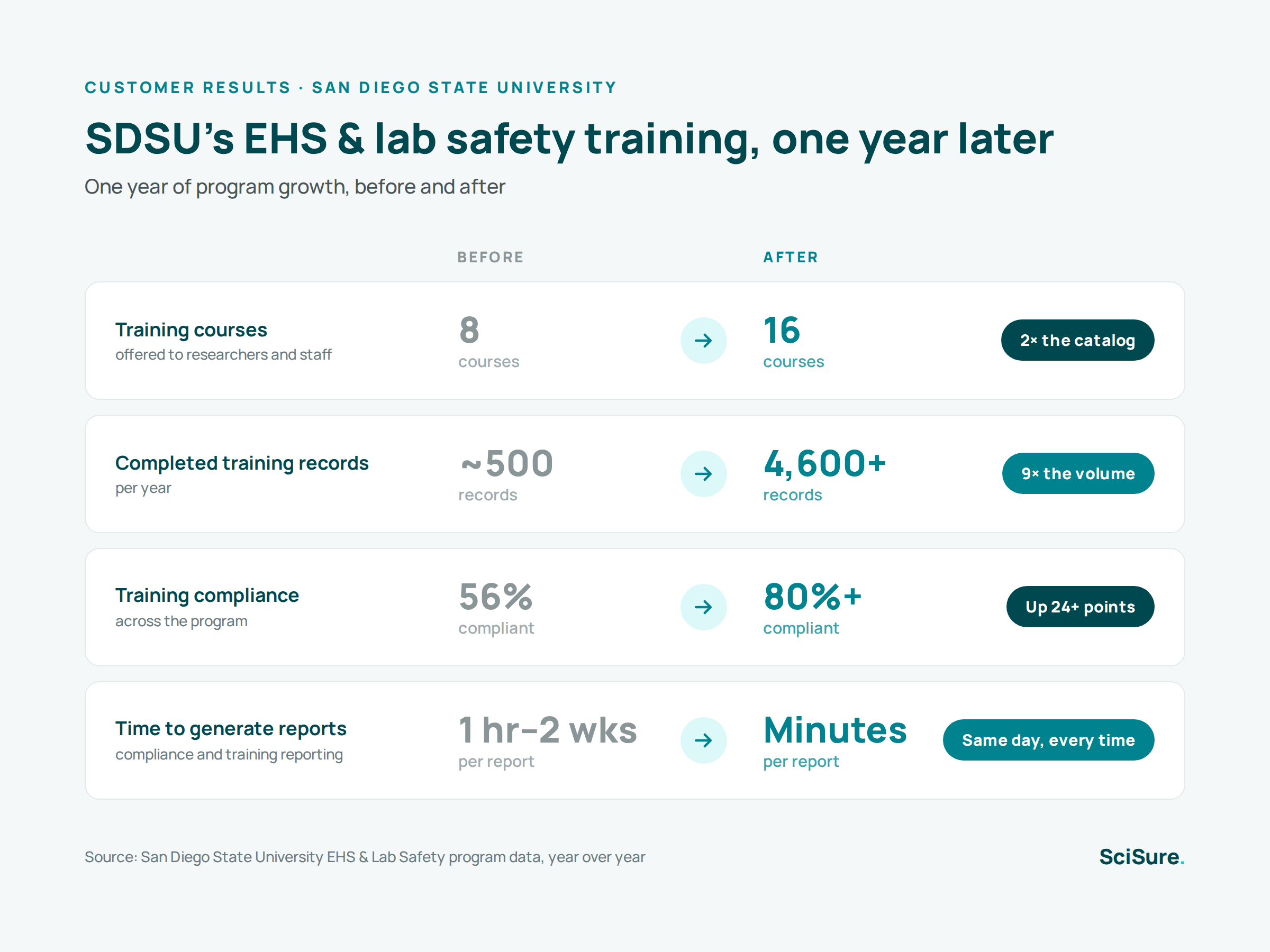
San Diego State University used SciSure's platform, Door Signs, ChemTracker, SDS, Hazardous Waste, and Radioisotope Management to gain hazard visibility across lab spaces. Training grew from 8 courses and roughly 500 records to 16 courses and over 4,600. Compliance rose from 56% to above 80%, and reporting that took up to two weeks now runs in minutes
This post was originally published in 2020 and has been fully updated to reflect SciSure's positioning as a Scientific Management Platform, current industry research and safety benchmarks, and new customer results from San Diego State University.
Ready to see SciSure in action?
No commitment · Free consultation
As a startup, leveling up can be exhilarating and terrifying at the same time. You run into new requirements, new hazards, new facilities questions, and new operational problems before you have the headcount or institutional memory of a larger company.
That matters because lab safety is an operating system for growth, beyond simply a compliance issue. The latest Bureau of Labor Statistics Survey of Occupational Injuries and Illnesses reported 5.5 thousand nonfatal injury and illness cases in scientific research and development services in 2024, including 2.3 thousand cases involving days away from work, restriction, or transfer. Testing laboratories had a higher total recordable case rate than scientific R&D overall: 1.6 cases per 100 full-time workers versus 0.6 for scientific R&D services. OSHA also ranked Hazard Communication as the second most frequently cited federal OSHA standard in fiscal year 2025, which is a useful reminder that chemical safety paperwork only matters when it reflects what is actually happening in the lab.
Regulatory hurdles and safety issues should not be the reason your startup loses time, money, or momentum. We originally spoke with Corey Martin, founder and CEO of Spotlight Safety Inc., about the most common lab safety challenges and tripping points startups face. The concerns are still highly relevant, but the risk landscape has sharpened: OSHA updated the Hazard Communication Standard in 2024, EPA hazardous waste thresholds still change your obligations as waste volume increases, and biosafety expectations continue to evolve around institutional oversight and incident reporting.
No matter what stage your company is in, it's never too early to build a safety program that can scale with the science.
Here are eight common challenges to watch out for.
1. Wastewater regulations & permitting
Before signing a lease, make sure the property is equipped to handle the volume and makeup of wastewater you expect to produce. Ask whether the landlord or the tenant holds the relevant permits, whether the building discharges to a publicly owned treatment works (POTW), and whether any local pretreatment requirements apply.
EPA's industrial wastewater guidance notes that NPDES permitting establishes discharge limits and conditions for industrial and commercial sources, while the National Pretreatment Program addresses non-domestic discharges into municipal sewer systems. For a growing lab, that means wastewater is not only a question of "Can this go down the drain?" It is a question of activity type, local discharge limits, waste profile, treatment infrastructure, and who has permitting responsibility.
Take the time to estimate the types and volumes of wastewater you expect to produce over the full length of your occupancy, not just during the first few months. New or remodeled systems can carry substantial capital costs, and permitting timelines can vary significantly by location and discharge complexity.
Even if state or local permitting requirements do not appear to apply, it's still a good idea to contact the municipal wastewater authority early. That conversation can clarify whether your projected work creates concerns around pH, solvents, metals, disinfectants, biological materials, radionuclides, PFAS, or other regulated constituents before you're locked into a space.
2. OSHA Bloodborne Pathogen Standard
OSHA's Bloodborne Pathogens Standard applies to occupational exposure to blood or other potentially infectious materials. It requires employers with covered exposure to establish a written Exposure Control Plan, make exposure determinations, use engineering and work-practice controls, provide PPE where needed, and train employees at initial assignment and at least annually thereafter. Bloodborne pathogens are a major concern for startups that handle human blood, human cell lines, human tissues, or other potentially infectious materials.
The standard also requires employers to make hepatitis B vaccination available to employees with occupational exposure after they receive required training and within 10 working days of initial assignment, unless an exception applies.
For a startup, the practical issue is more than,"Do we have a BBP training slide deck?" It is whether you know which roles, tasks, materials, and locations create occupational exposure, and whether that information stays current as projects change.

3. Hazardous waste management
Chemical waste, biological waste, sharps, radioactive waste, contaminated debris, and broken glassware can create risk for employees, facilities teams, transporters, and downstream disposal vendors if handled incorrectly. EPA classifies hazardous waste generators by the quantity generated in a calendar month.
- Very Small Quantity Generators generate 100 kilograms (220 pounds) or less of hazardous waste per month or 1 kilogram (2.2 pounds) or less of acutely hazardous waste.
- Small Quantity Generators generate more than 100 kilograms but less than 1,000 kilograms per month.
- Large Quantity Generators generate 1,000 kilograms per month or more, or more than 1 kilogram of acutely hazardous waste.
These thresholds matter because generator status affects accumulation limits, emergency preparedness, manifests, documentation, training expectations, and reporting requirements. A startup can move from one category to another simply by adding instruments, scaling protocols, taking on new chemistry, or consolidating waste pickups.
The best early move is to make waste management visible. Train people on waste identification, labeling, storage, segregation, and pickup procedures. Then track waste generation in a way that lets you see when your volume, waste streams, or storage practices are changing.
SciSure's Hazardous Waste workflows can help standardize waste stream profiles, pickup requests, lab-level waste histories, open request tracking, and exportable reports. This is useful when your team needs to move beyond informal Slack messages or paper pickup forms.
4. Chemical purchasing & inventory management
A chemical that costs $50 up front can become expensive once you account for storage, segregation, flammable limits, SDS access, expiration, waste classification, spill response, and disposal. Bulk buying can look efficient until the material expires, requires special storage, pushes a control area closer to a fire-code threshold, or creates a new waste stream.
So before ordering a chemical, consider:
- Its expected rate of use
- Its expiration date and stability
- Storage requirements
- Hazard classification
- Flammable and combustible liquid quantities
- Control area limits and maximum allowable quantities
- Waste stream compatibility
- Whether the material requires new SOPs, training, or approvals
The Safety Data Sheet should be reviewed before ordering, not only after the chemical arrives. This matters even more after OSHA's 2024 Hazard Communication update, which aligned the standard primarily with the seventh revised edition of the Globally Harmonized System and was intended to improve hazard information on labels and SDSs.
One way to reduce uncertainty is to keep chemical purchasing tied to container-level inventory and SDS management. A robust system can flag duplicate orders, help prevent over-purchasing, improve emergency visibility, and make it easier to answer basic but high-stakes questions: What do we have? Where is it? Who owns it? What hazards does it carry? What regulatory thresholds does it affect?
Where SciSure fits after chemical purchasing
SciSure's ChemTracker module supports container-level chemical inventory, a central chemical database with hazard and regulatory data, SDS auto-match, manually attached SDSs, and reporting by regulation. The SDS auto-match workflow can attach SDSs to chemical containers and recheck eligible containers over time as newer SDSs become available.
For safety and compliance teams, ChemTracker reports can help move chemical inventory from a static spreadsheet to an operational control point. Available reports include:
- Containers by Regulation
- Totals by Regulation
- Federal Tier II / RTK-style reports
- State and local Tier II-type reports where configured
- NFPA reports
- Fire code reports using IBC categories and maximum allowable quantity references
- Fire Code Chemical Listings for deeper analysis
This doesn't replace local code review or EHS judgment, but it gives a growing team a much better starting point than trying to reconstruct chemical risk from purchase orders and cabinet labels.
5. Peroxide former management
As peroxides form, these materials can become increasingly hazardous, especially if they're old, improperly stored, exposed to air or light, or allowed to evaporate. The danger is often not the bottle everyone remembers using; it's the bottle that was purchased for a short-lived experiment and then forgotten in the back of a cabinet.
So make sure you:
- Buy only what you need.
- Label receipt and opening dates.
- Track expiration and retest dates.
- Store materials according to SDS and institutional requirements.
- Assign ownership for testing and disposal.
- Remove expired or suspect containers through the proper waste process.
Chemical inventory software can help by showing how quickly a lab actually uses a chemical, how many containers exist, where they are stored, and which materials need attention. Self-inspection workflows can also help teams document peroxide-former checks, chemical maintenance, and follow-up actions.
6. Flammable storage and control area limits
An unexpected fire or explosion can cause injuries, facility damage, equipment loss, downtime, lease problems, and investor-facing disruption. Flammable material risk is manageable, but only if your team understands both the stock chemicals and the waste accumulating onsite.
Flammable solvents are common in lab research. HPLCs and mass spectrometers can generate meaningful volumes of flammable solvent waste during normal use. If you add instruments, assays, or headcount without recalculating storage and waste needs, you can quickly create a mismatch between the science and the space.
Ask these questions before scaling:
- What flammable liquids will be stored in each room?
- What waste volumes will be generated each month?
- Are flammable cabinets, refrigerators, containers, and grounding/bonding practices appropriate?
- What does the lease say about hazardous materials and decommissioning?
- What control areas apply, and what maximum allowable quantities apply?
- How will fire-code, waste, and inventory data stay current?
OSHA's Laboratory Standard requires a written Chemical Hygiene Plan for workplaces where hazardous chemicals are used in laboratories, and the plan must be capable of protecting employees from chemical health hazards and keeping exposures below applicable limits. The Chemical Safety Board's Texas Tech University case study also emphasized that research organizations must control physical hazards of chemicals, not only health hazards.
Read More: Chemistry Lab Safety Guide: 14 Rules For A Safer Lab
7. Hazardous waste generator status: the switch from VSQG to SQG
The switch from Very Small Quantity Generator to Small Quantity Generator status trips up many growing startups. The reason is simple: generator status is based on how much hazardous waste you generate in a calendar month, not on company size, funding stage, or whether you feel like a "real" operation yet.
EPA's federal thresholds are:
- VSQG: 100 kilograms or less of hazardous waste per month, or 1 kilogram or less of acutely hazardous waste per month
- SQG: more than 100 kilograms but less than 1,000 kilograms of hazardous waste per month
- LQG: 1,000 kilograms or more of hazardous waste per month, or more than 1 kilogram of acutely hazardous waste per month
SQGs may accumulate hazardous waste onsite for 180 days without a permit, or 270 days if shipping more than 200 miles, but the quantity onsite must not exceed 6,000 kilograms. LQGs generally have a 90-day accumulation limit and must submit biennial hazardous waste reports.
The operational lesson is to monitor monthly generation before you are close to a threshold. If you only discover the change after pickups, manifests, storage practices, or emergency arrangements are already out of sync, the fix becomes more expensive.
8. Signing a new lease
Moving into a new space is exciting, but it is also where many "unknown unknowns" become expensive. Before signing, look beyond square footage and bench count. Ask about:
- Wastewater permits and pretreatment limits
- Hazardous material limits and control areas
- Flammable storage infrastructure
- Ventilation and fume hood capacity
- Emergency showers and eyewashes
- Sprinklers and fire protection
- Waste accumulation areas
- Chemical storage rooms and cabinets
- Decommissioning requirements
- Radioactive, biological, or controlled-substance limitations
- Landlord notification and approval requirements for hazardous materials
In many cases, the most expensive safety issues appear either when you try to scale or when you try to leave. A certified decommissioning bill, unexpected hazardous waste pickup costs, or a facility limitation discovered after move-in can slow research at exactly the wrong moment.
The better question is not "Can we do today's work here?" It is "Can this space support our next three years of work without forcing safety and compliance to catch up after the fact?"
Safety and compliance capabilities worth building early
Not every startup needs every module on day one, but these are the workflows worth planning for before spreadsheets become the system of record.
Chemical inventory & SDS management
Track chemicals at the container level, keep SDSs accessible, and connect inventory to hazard and regulatory data. This supports safer purchasing, storage, inspections, emergency response, and disposal.
Regulatory & fire-code reporting
Use chemical inventory data to support By Regulation reports, Tier II / RTK-style reporting, NFPA summaries, and fire-code / MAQ visibility where configured. This is especially useful when growth changes quantities by building, lab, space, or control area.
Hazardous waste workflows
Standardize waste stream profiles, pickup requests, open request review, lab-level waste histories, and exportable reports. This reduces the risk of informal processes as waste volume increases.
Training requirements & compliance visibility
Assign safety training based on role, lab, location, and hazard exposure. Track completion and lapsed training in real time so EHS is not reconciling records manually before an inspection.
Inspections, self-inspections & corrective actions
Use inspections and self-inspections to document findings, assign follow-up, and maintain an auditable record of proactive safety management. This is useful for chemical maintenance, equipment checks, peroxide-former tracking, SOP gaps, and training issues.
Incident, near-miss & safety observation reporting
Capture incidents, near misses, and safety observations in a system that supports investigation and follow-up. The CSB's Texas Tech recommendations specifically called for an incident and near-miss reporting system that can be used for learning, continuous improvement, and timely remedial action.
Door signs & emergency visibility
Generate standardized door signs with hazard icons, PPE icons, regulatory information, and NFPA information where configured. This helps responders, facilities teams, and EHS understand room-level hazards quickly.
Biosafety & radioisotope workflows
For startups working with biological materials, recombinant or synthetic nucleic acids, or radiological materials, plan for specialized oversight. NIH's biosafety policy page notes that the NIH Guidelines detail safety practices and containment procedures for recombinant or synthetic nucleic acid research, and that certain significant problems, violations, accidents, and illnesses must be reported to NIH OSP. For NIH-funded or institutionally reviewed work, those obligations should be reflected in the operating system your startup uses to manage the work.
A practical example: turning unknowns into usable EHS visibility
San Diego State University is a larger academic example, but the lesson is directly relevant to startups: safety teams cannot manage what they cannot see. Before implementing SciSure, SDSU's EHS team did not have reliable, current visibility into how many lab spaces existed, who was working in which labs, or what hazards those labs contained. The team started with SciSure's platform and Door Signs, then added ChemTracker and SDS, Hazardous Waste, and Radioisotope Management.
That changed the work from reactive searching to actionable oversight. SDSU could identify what hazards were present, communicate with the right people when safety-critical building issues occurred, and report with confidence that 100% of spaces where chemicals were used had been inspected. The team also had visibility into which labs were working with biological materials or other specific hazards.
The training results were concrete. SDSU's EHS/Lab Safety program expanded from eight training courses and about 500 completed records in a year to 16 courses and more than 4,600 completed records the next year. Training compliance increased from 56% to more than 80%. Reporting that once took an hour, 2.5 hours, or even two weeks could be generated in minutes.
For a startup, the scale is smaller, but the pattern is the same. The earlier you connect people, spaces, hazards, inventory, training, inspections, waste, and incident records, the less likely safety becomes a scramble after the science has already scaled.
If this resonates, get in touch with us, and let's discuss how your safety standards can scale alongside your growth.
.png)
Read more of our blogs about modern lab management
Discover the latest in lab operations, from sample management to AI innovations, designed to enhance efficiency and drive scientific breakthroughs.