LIMS Validation: Requirements, Steps and Checklist

A practical guide to LIMS validation for regulated labs. Covers when it's required, IQ/OQ/PQ, URS/FRS, risk-based testing, and what SciSure provides to support your validation process.

August 24, 2026
()
min read
Un laboratoire

Download Whitepaper

By submitting this form, you agree with our Privacy Policy.
Thank you! Download the file by clicking below:
Download
Oops! Something went wrong while submitting the form.

Table of Contents

Thank you! Your submission has been received!
Oops! Something went wrong while submitting the form.

Table of Contents

TL;DR

  • LIMS validation is documented, auditable evidence that a Laboratory Information Management System installs correctly, operates as specified, and performs reliably under real laboratory conditions.
  • Validation is required when a LIMS supports records or processes subject to applicable GMP, GLP, or other regulated computerized-system requirements. ISO/IEC 17025 also requires laboratories to validate the functionality of information-management systems used to collect, process, record, report, store, or retrieve laboratory data, including interfaces, before use. The required scope depends on intended use and risk. 
  • A validation package commonly includes documented intended use and system requirements, a risk assessment, supplier and configuration evidence, verification protocols and results, deviation records, requirements traceability, and documented approval for release. Organizations may use documents such as a URS, FRS, IQ, OQ, and PQ, but the exact deliverables should reflect the applicable framework, system architecture, intended use, and risk.
  • Validation remains the regulated organization's responsibility even with a SaaS vendor, though platforms like SciSure can provide audit trails, role-based access controls, and electronic signatures that support 21 CFR Part 11 requirements.
  • Arctic Therapeutics, an ISO 15189 certified biotech lab in Iceland, centralized experiment documentation and record locking in SciSure and cut roughly two hours a week from manual registration and inventory tracking.

LIMS validation is the process of generating documented evidence that a Laboratory Information Management System (LIMS) does what it’s intended to do, consistently and verifiably, under conditions a regulator or auditor can inspect. That evidence covers installation, day-to-day operation, and performance under real laboratory conditions, built up through defined requirements, structured testing, and signed documentation.

In regulated environments, failing to validate a LIMS used for regulated records or quality-critical processes can result in audit or inspection observations and create significant data-integrity risk. Whether validation is required, and how extensive it must be, depends on the system’s intended use, the applicable regulations or standards, and a documented risk assessment. Remediating validation gaps after an inspection can also be considerably more disruptive and costly than addressing them before go-live.

What is LIMS validation?

LIMS validation is the structured, documented process of confirming that a LIMS is correctly installed, operates as specified, and performs reliably under real laboratory conditions. It answers one specific question for an auditor: can this system be trusted with regulated data, and is there evidence on file to prove it?

That framing matters because validation is broader than software testing. Testing is one source of validation evidence and may include functional, integration, security, performance, and user-acceptance testing. Validation connects that evidence to the system’s documented intended use, requirements, risks, configuration, procedures, and formal approval. A feature may work technically but still lack adequate validation evidence if the result was not documented, reviewed, or traced to an approved requirement or risk. 

You start seeing the benefits of LIMS the day a system goes live, quicker sample tracking, centralized records, fewer manual entry steps. Validation documents that value in a form you can defend to an auditor.

Why LIMS validation matters

Skipping or under-documenting LIMS validation lets risk accumulate quietly until it surfaces as an audit observation or a data integrity finding during an inspection. System features and laboratory procedures provide the controls that keep regulated data trustworthy, including appropriate audit trails, access permissions, electronic signatures, and record retention. Validation provides documented evidence that the configured controls operate as intended for the laboratory’s defined use. Those controls must also be supported by procedures, training, administration, and ongoing change control. 

Remediation after an inspection is slower and costlier than validating properly up front: retesting under regulatory scrutiny, freezing system changes mid-project, and explaining documentation gaps to an auditor who has already found one. The credibility of every result your LIMS records rests on this evidence existing before anyone asks for it.

Arctic Therapeutics, an ISO 15189 certified biotech lab in Iceland, shows what this looks like in practice. Centralizing experiment documentation in SciSure, with controlled access, signing, and record locking, keeps the lab's data audit ready and suitable for clinical and regulatory use, and the team estimates saving roughly two hours a week that used to go into manual registration and inventory tracking. Read the full Arctic Therapeutics story.

Who needs to validate a LIMS, and when

LIMS validation is required when the system supports regulated records, decisions, or processes for which the applicable framework requires validated computerized systems. This commonly includes LIMS used in GMP manufacturing and quality control, GLP non-clinical safety studies, and other FDA- or EU-regulated activities. ISO/IEC 17025 requires laboratories to validate the functionality of information-management systems before introduction, but it does not prescribe the same validation lifecycle or documentation structure used in every GxP environment.

A new LIMS should be validated or otherwise verified as required for its intended use before the laboratory relies on it for in-scope work. Software upgrades, configuration changes, new integrations, and data migrations should then undergo documented impact and risk assessment. Testing or revalidation should be proportionate to the functions and records affected by the change.

From there, major software upgrades, significant configuration changes, and any integration with instruments or third-party systems each reopen the question of whether the system still performs as specified. Migrating data from a legacy system or spreadsheets carries its own risk, since bad data can move into a new system just as easily as good data, and validation confirms which one actually happened.

Growing labs outside these formal regulatory requirements tend to reach the same need for structure from a different direction. Once sample management volume passes the point where manual checks are practical, or once downstream decisions start depending on what the LIMS reports, documented validation becomes a safeguard worth having regardless of whether an auditor will ever ask for it. It's the same inflection point that pushes many small labs from spreadsheets into a structured system in the first place, worth a look at our guide on LIMS for small labs if you're at that stage.

Regulations, standards, and guidance

Five terms come up constantly in LIMS validation conversations, and QA managers tend to notice when they get flattened into one bucket. Each falls into a different category: 

  • Something you can be cited against
  • Something you get accredited to
  • Guidance you use at your own discretion

Getting that distinction right matters as much as knowing the names.

  1. FDA 21 CFR Part 11 is a regulation governing electronic records and electronic signatures used to meet FDA recordkeeping or submission requirements. Its applicability depends on the underlying FDA predicate rules and whether the required records are maintained electronically. Part 11 includes controls related to system access, operational and authority checks, system documentation, electronic signatures, and, where applicable, trustworthy and reliable electronic records. FDA recommends that validation scope be based on a justified and documented risk assessment.  retention.
  2. EU GMP Annex 11 is European Commission guidance within EudraLex Volume 4 for computerized systems used in GMP-regulated activities. It requires the application to be validated and IT infrastructure to be qualified, with the extent of validation and data-integrity controls based on documented risk assessment. The 2011 revision remains the version currently listed as in force. A revised draft was published for consultation in July 2025 but is not yet the operative version, so organizations should monitor the official EudraLex page rather than assume a particular effective date. 
  3. ISO/IEC 17025 is the international accreditation standard for testing and calibration laboratories. It requires information-management systems used to collect, process, record, report, store, or retrieve laboratory data to be validated for functionality before introduction, including the proper functioning of interfaces. Changes must also be authorized, documented, and validated before implementation. The standard does not prescribe a specific GxP-style IQ/OQ/PQ document set. 
  4. GxP is an umbrella term spanning several Good Practice standards, including GLP and GMP. GxP compliance always resolves to whichever specific standard actually governs the lab's work, GLP for non-clinical safety studies, GMP for manufacturing.
  5. GAMP 5 is industry guidance from ISPE, built around a risk-based categorization framework that many regulated organizations use to scale validation efforts. Auditors inspect against Part 11 or Annex 11 directly; GAMP 5 shapes how a lab gets there.
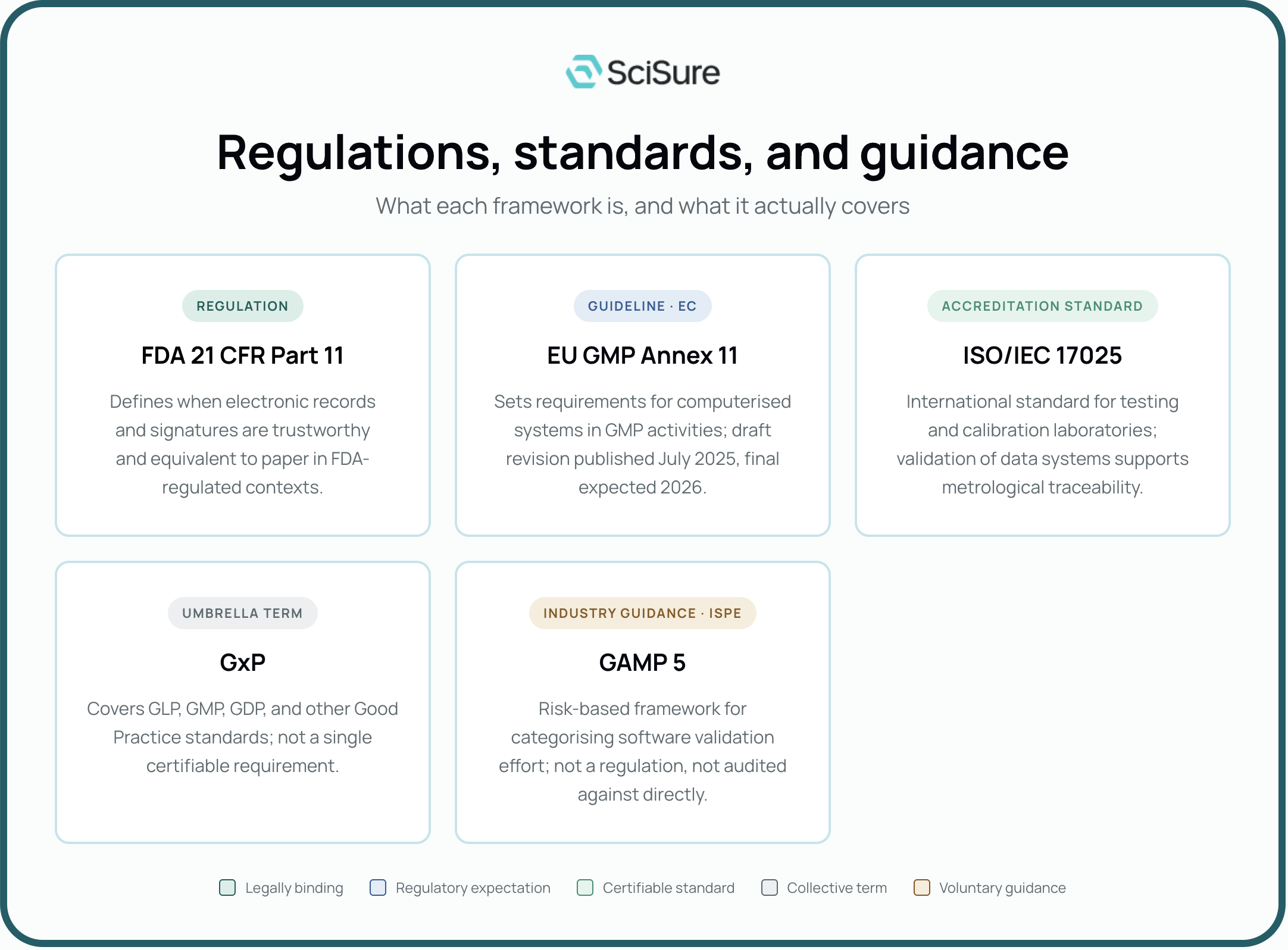
Regulations. standards and guidance overview

How to build a LIMS validation plan

A LIMS validation plan is the document that defines the scope, objectives, timelines, responsibilities, and risk assessment for the validation project. It's approved before any testing begins and referenced throughout the work that follows. Without it, IQ/OQ/PQ testing is just testing. With it, the same testing becomes documented evidence an auditor can trace back to a decision.
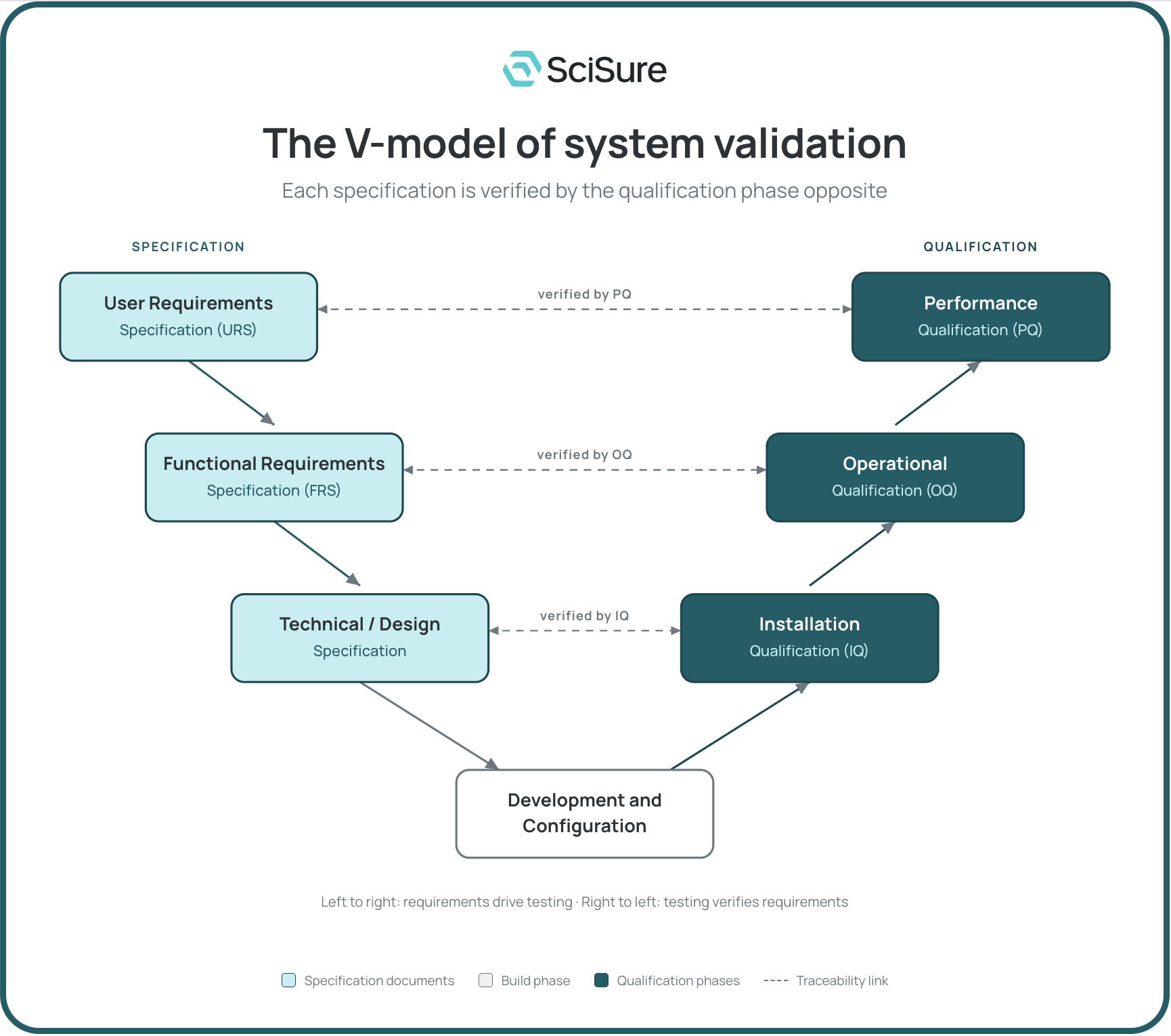
How to build a LIMS validation plan

Defining requirements: URS and FRS

The User Requirements Specification, or an equivalent requirements document, captures what the laboratory needs the system to do in terms of its intended scientific, operational, data-integrity, and regulatory use. A separate Functional Requirements Specification may then describe how the system or its configured functions will meet those needs, although not every validation approach requires a standalone FRS. The essential requirement is that relevant needs and controls are documented clearly enough to assess, configure, verify, and trace. This includes identifying where audit trails, access controls, electronic signatures, metadata, retention, calculations, interfaces, or other data-integrity controls are required. 

IQ, OQ and PQ explained

IQ, OQ, and PQ are commonly used qualification stages, but GAMP 5 does not require every organization to use three separate phases or a fixed set of documents. A risk-based validation approach may combine or adapt these activities according to the system, deployment model, supplier evidence, intended use, and applicable requirements.

Installation Qualification (IQ) provides evidence that the required system components and environment have been installed or provisioned correctly. For an on-premises system, this may include hardware, operating systems, application versions, and installation records. For SaaS, relevant installation and infrastructure evidence may be maintained primarily by the supplier and assessed through supplier documentation and agreements.

Operational Qualification (OQ) verifies that relevant configured functions and controls operate as specified. Testing may cover calculations, permissions, audit trails, electronic signatures, date and time handling, error handling, interfaces, and other functions identified as significant through risk assessment. It is not necessary to test every possible function to the same depth.

Performance Qualification (PQ), user-acceptance testing, or equivalent use-case verification demonstrates that the configured system supports the laboratory’s intended workflows under representative operating conditions. Representative test data should be used unless controlled use of actual data is justified and approved.

The traceability matrix

The traceability matrix links requirements to the evidence used to verify them, which may include executed test cases, document review, supplier evidence, configuration review, or procedural controls. It helps demonstrate that each in-scope requirement has been addressed and that any exclusions or alternative forms of verification are justified. 

Validation documentation and deliverables

Validation documentation should provide traceable evidence that the system is suitable for its intended use. Depending on the applicable framework and risk, the package may include a validation plan, intended-use statement, URS or equivalent requirements, risk assessments, supplier-assessment records, configuration specifications, IQ/OQ/PQ or other verification protocols, executed results, deviation records, a traceability matrix, and a validation summary or release approval. Not every project requires a separate FRS or three distinct IQ/OQ/PQ phases. Backup and restoration should be tested where they are necessary to protect regulated or quality-critical data. Validation records should remain under document control for the applicable retention period.

SciSure LIMS
See how SciSure supports LIMS validation
A SciSure specialist can walk you through the audit trails, access controls, and documentation that support your validation process.
Talk to a specialist

Risk-based validation: where to focus testing effort

Risk-based validation means concentrating verification effort on functions with the greatest potential impact on patient safety, product quality, data integrity, and compliance. GAMP 5 provides a risk-based framework and categorizes the components that make up computerized systems according to their nature and the amount of configuration or customization involved. The current framework does not simply sort whole systems into consecutive categories 1 through 5, and categorization does not determine the required testing by itself. The organization’s assessment of intended use, GxP impact, complexity, novelty, supplier capability, and functional risk should determine the validation approach. 

In practice, a handful of areas consistently carry the most risk and earn the deepest testing. Electronic records sit at the top, since any gap here undermines the evidence the whole validation package is built on. Calculation functions follow closely: a formula that silently returns the wrong result can propagate bad data through every downstream decision. Audit trails and access controls need thorough testing because they're what an auditor checks first when assessing whether the system's data can be trusted. Any point where the LIMS connects to instruments or external systems also demands close attention, since LIMS integration points are where data enters or leaves the validated environment, and a failure there can compromise everything downstream of it.

Who owns validation: vendor responsibilities vs lab responsibilities

Ultimate accountability for validating a LIMS used in regulated work remains with the regulated organization. A software vendor, consultant, or other service provider may supply documentation, execute protocols, assist with risk assessments, or perform validation activities under an agreed scope. However, the regulated organization must define and approve the intended use and requirements, assess the supplier, determine whether the evidence is adequate, approve the system for use, and maintain the validated state. Supplier work can support the organization’s validation but does not transfer that accountability.

What the vendor or service provider can provide What the regulated organization must retain responsibility for
Product, infrastructure, and installation documentation Define and approve intended use and user requirements
Quality-system, development-lifecycle, and supplier-assessment evidence Assess the supplier and determine whether its evidence is adequate
Configuration and technical specifications Approve the implemented configuration and its regulated scope
Vendor testing, executed protocols, or protocol templates Determine what additional customer-specific verification is required
Audit-trail, electronic-signature, and access-control functionality Verify that applicable controls work in the organization's configured use
Assistance executing IQ, OQ, PQ, or other verification activities Review deviations, approve validation conclusions, and release the system
Release notes, change information, support, and training Maintain procedures, training, change control, periodic review, and validation records
What the vendor can provide What the lab must do
IQ documentation and installation records Execute IQ in the lab's own environment and verify against vendor documentation
Test script templates and configuration guides Define intended use and adapt test scripts to the lab's specific configuration
Audit trail, e-signature, and access control functionality Validate that these controls operate correctly in the lab's specific deployment
Vendor audit reports and quality system documentation Review vendor documentation and assess its adequacy for the lab's own validation package
Support and training during validation Approve the validation summary report and retain all documentation under the lab's own document control system

How much of this a vendor actually hands over varies widely. Some provide IQ documentation and test script templates that meaningfully cut down the lab's work at the installation layer. Others offer far less, which makes it worth asking a vendor exactly what validation-support documentation exists before signing a contract, not after.

Validating a cloud or SaaS LIMS: what to ask your vendor

Cloud and SaaS LIMS introduce validation questions that on-premises systems don't raise. A system a vendor updates continuously, hosts on shared infrastructure, and manages behind the scenes shifts several validation questions onto the vendor relationship itself, and getting clear answers before signing matters as much as the testing that follows.

Start with update cadence: ask how software updates are communicated and assessed for validation impact, since an unannounced update can quietly break a validated state without anyone noticing until an audit does. Ask what supplier-assessment evidence the vendor can provide, including quality-system documentation, software-development and change-control information, service descriptions, security certifications, and relevant independent audit reports. A SOC 2 report can inform the laboratory’s supplier, security, availability, and control assessment, but it does not validate the LIMS for the laboratory’s intended use or automatically replace customer-specific verification. Data residency and backup deserve the same scrutiny: where data physically lives, how backups run, and whether restoration has actually been tested, not just scheduled.

Ask whether the vendor operates under a formal quality management system, since that shapes how consistently they handle change control on their end. And in a multi-tenant environment, confirm exactly how access controls and audit trails stay isolated between customers, along with the cybersecurity controls protecting regulated data in transit and at rest, since shared infrastructure raises the stakes on both.

Keeping the system validated: change control and revalidation

A validated LIMS stays validated only as long as the system matches what was tested and approved, which means change control has to run continuously alongside the system itself. Software updates, configuration changes, new integrations, organizational changes that affect access or roles, and data migration events all trigger a change control review before anything goes live.

The review's job is to assess impact: does this change touch a function that was part of the original validated scope, and if so, how much retesting does it need? A minor configuration tweak with no bearing on records, calculations, or access might only need targeted, partial revalidation of the affected area. A major upgrade, a new instrument integration, or a significant shift in how data flows through the system usually calls for full revalidation of the functions involved.

Change control is what keeps a validation current between major projects. Skip it consistently enough, and a system that was fully validated at go-live quietly becomes an audit risk, one undocumented change at a time.

SciSure LIMS
Ready to see SciSure in action?
Get a live walkthrough of how SciSure's audit trails, role-based access, and electronic signatures support a validated research environment.
Request a demo

FAQ

What is LIMS validation?

LIMS validation is documented evidence that a LIMS performs as intended, consistently, under conditions a regulator or auditor can inspect. It covers the system's intended use, structured and recorded testing, and a signed approval before the system handles regulated data. General QA testing checks that software works; validation proves it works for a specific, defined purpose and keeps the proof on file.

Why is LIMS validation important?

LIMS validation protects a lab from regulatory observations and data integrity findings during an inspection. An unvalidated system that produces a bad result doesn't just create one error, it calls every result that depended on that system into question. Remediation after the fact means retesting under scrutiny, freezing changes mid-project, and rebuilding documentation an auditor has already flagged as missing.

When is LIMS validation required?

LIMS validation is required when the system supports records or processes covered by regulations or standards that require validated computerized systems or validated information-management functionality. This commonly includes GMP and GLP activities and LIMS used within ISO/IEC 17025-accredited laboratories. New implementations should be validated before the system is relied on for in-scope work. Upgrades, configuration changes, integrations, and data migrations should undergo documented impact assessment, with targeted testing or revalidation based on the associated risk. 

What is included in a LIMS validation?

A LIMS validation package should document the system’s intended use, requirements, risk assessment, configuration, verification activities, results, deviations, traceability, and approval for release. Many organizations structure this evidence through a validation plan, URS, FRS, IQ, OQ, PQ, traceability matrix, and validation summary report. However, that exact set of documents is not universally mandatory; the approach and deliverables should be proportionate to the system’s intended use, complexity, applicable requirements, and risk.

How long does LIMS validation typically take?

LIMS validation timelines vary widely, and there is no defensible universal range. A limited, well-defined SaaS implementation may be completed in weeks or a few months, while a highly configured system with multiple interfaces, extensive data migration, several sites, or complex regulated workflows may take considerably longer. The main drivers are scope, risk, configuration complexity, supplier documentation, integration testing, migration, internal review capacity, and the time needed to resolve deviations. 

What are the main components of a LIMS validation plan?

A LIMS validation plan defines scope and objectives, timeline and resource allocation, risk assessment, roles and responsibilities, the regulatory frameworks that apply, and documentation requirements for every validation activity. It's approved before testing begins and gets referenced throughout the project, so everyone involved is working from the same defined boundaries.

Can SciSure assist with the validation process?

SciSure supports the core technical requirements regulated labs validate against: audit trails with automatic timestamps and user attribution, role-based access and permissions, and electronic signatures that lock records once signed, built to support FDA 21 CFR Part 11 workflows. SciSure provides a system built to be validatable, backed by documentation that supports the lab's own process. Defining intended use, executing OQ/PQ in the lab's own environment, and maintaining change control stay the regulated organization's responsibility throughout.

Ready to see SciSure in action?

Get a personalized demo and see how SciSure fits your lab's workflows.
Request demo

No commitment · Free consultation

LIMS validation is the process of generating documented evidence that a Laboratory Information Management System (LIMS) does what it’s intended to do, consistently and verifiably, under conditions a regulator or auditor can inspect. That evidence covers installation, day-to-day operation, and performance under real laboratory conditions, built up through defined requirements, structured testing, and signed documentation.

In regulated environments, failing to validate a LIMS used for regulated records or quality-critical processes can result in audit or inspection observations and create significant data-integrity risk. Whether validation is required, and how extensive it must be, depends on the system’s intended use, the applicable regulations or standards, and a documented risk assessment. Remediating validation gaps after an inspection can also be considerably more disruptive and costly than addressing them before go-live.

What is LIMS validation?

LIMS validation is the structured, documented process of confirming that a LIMS is correctly installed, operates as specified, and performs reliably under real laboratory conditions. It answers one specific question for an auditor: can this system be trusted with regulated data, and is there evidence on file to prove it?

That framing matters because validation is broader than software testing. Testing is one source of validation evidence and may include functional, integration, security, performance, and user-acceptance testing. Validation connects that evidence to the system’s documented intended use, requirements, risks, configuration, procedures, and formal approval. A feature may work technically but still lack adequate validation evidence if the result was not documented, reviewed, or traced to an approved requirement or risk. 

You start seeing the benefits of LIMS the day a system goes live, quicker sample tracking, centralized records, fewer manual entry steps. Validation documents that value in a form you can defend to an auditor.

Why LIMS validation matters

Skipping or under-documenting LIMS validation lets risk accumulate quietly until it surfaces as an audit observation or a data integrity finding during an inspection. System features and laboratory procedures provide the controls that keep regulated data trustworthy, including appropriate audit trails, access permissions, electronic signatures, and record retention. Validation provides documented evidence that the configured controls operate as intended for the laboratory’s defined use. Those controls must also be supported by procedures, training, administration, and ongoing change control. 

Remediation after an inspection is slower and costlier than validating properly up front: retesting under regulatory scrutiny, freezing system changes mid-project, and explaining documentation gaps to an auditor who has already found one. The credibility of every result your LIMS records rests on this evidence existing before anyone asks for it.

Arctic Therapeutics, an ISO 15189 certified biotech lab in Iceland, shows what this looks like in practice. Centralizing experiment documentation in SciSure, with controlled access, signing, and record locking, keeps the lab's data audit ready and suitable for clinical and regulatory use, and the team estimates saving roughly two hours a week that used to go into manual registration and inventory tracking. Read the full Arctic Therapeutics story.

Who needs to validate a LIMS, and when

LIMS validation is required when the system supports regulated records, decisions, or processes for which the applicable framework requires validated computerized systems. This commonly includes LIMS used in GMP manufacturing and quality control, GLP non-clinical safety studies, and other FDA- or EU-regulated activities. ISO/IEC 17025 requires laboratories to validate the functionality of information-management systems before introduction, but it does not prescribe the same validation lifecycle or documentation structure used in every GxP environment.

A new LIMS should be validated or otherwise verified as required for its intended use before the laboratory relies on it for in-scope work. Software upgrades, configuration changes, new integrations, and data migrations should then undergo documented impact and risk assessment. Testing or revalidation should be proportionate to the functions and records affected by the change.

From there, major software upgrades, significant configuration changes, and any integration with instruments or third-party systems each reopen the question of whether the system still performs as specified. Migrating data from a legacy system or spreadsheets carries its own risk, since bad data can move into a new system just as easily as good data, and validation confirms which one actually happened.

Growing labs outside these formal regulatory requirements tend to reach the same need for structure from a different direction. Once sample management volume passes the point where manual checks are practical, or once downstream decisions start depending on what the LIMS reports, documented validation becomes a safeguard worth having regardless of whether an auditor will ever ask for it. It's the same inflection point that pushes many small labs from spreadsheets into a structured system in the first place, worth a look at our guide on LIMS for small labs if you're at that stage.

Regulations, standards, and guidance

Five terms come up constantly in LIMS validation conversations, and QA managers tend to notice when they get flattened into one bucket. Each falls into a different category: 

  • Something you can be cited against
  • Something you get accredited to
  • Guidance you use at your own discretion

Getting that distinction right matters as much as knowing the names.

  1. FDA 21 CFR Part 11 is a regulation governing electronic records and electronic signatures used to meet FDA recordkeeping or submission requirements. Its applicability depends on the underlying FDA predicate rules and whether the required records are maintained electronically. Part 11 includes controls related to system access, operational and authority checks, system documentation, electronic signatures, and, where applicable, trustworthy and reliable electronic records. FDA recommends that validation scope be based on a justified and documented risk assessment.  retention.
  2. EU GMP Annex 11 is European Commission guidance within EudraLex Volume 4 for computerized systems used in GMP-regulated activities. It requires the application to be validated and IT infrastructure to be qualified, with the extent of validation and data-integrity controls based on documented risk assessment. The 2011 revision remains the version currently listed as in force. A revised draft was published for consultation in July 2025 but is not yet the operative version, so organizations should monitor the official EudraLex page rather than assume a particular effective date. 
  3. ISO/IEC 17025 is the international accreditation standard for testing and calibration laboratories. It requires information-management systems used to collect, process, record, report, store, or retrieve laboratory data to be validated for functionality before introduction, including the proper functioning of interfaces. Changes must also be authorized, documented, and validated before implementation. The standard does not prescribe a specific GxP-style IQ/OQ/PQ document set. 
  4. GxP is an umbrella term spanning several Good Practice standards, including GLP and GMP. GxP compliance always resolves to whichever specific standard actually governs the lab's work, GLP for non-clinical safety studies, GMP for manufacturing.
  5. GAMP 5 is industry guidance from ISPE, built around a risk-based categorization framework that many regulated organizations use to scale validation efforts. Auditors inspect against Part 11 or Annex 11 directly; GAMP 5 shapes how a lab gets there.
Regulations. standards and guidance overview

How to build a LIMS validation plan

A LIMS validation plan is the document that defines the scope, objectives, timelines, responsibilities, and risk assessment for the validation project. It's approved before any testing begins and referenced throughout the work that follows. Without it, IQ/OQ/PQ testing is just testing. With it, the same testing becomes documented evidence an auditor can trace back to a decision.

How to build a LIMS validation plan

Defining requirements: URS and FRS

The User Requirements Specification, or an equivalent requirements document, captures what the laboratory needs the system to do in terms of its intended scientific, operational, data-integrity, and regulatory use. A separate Functional Requirements Specification may then describe how the system or its configured functions will meet those needs, although not every validation approach requires a standalone FRS. The essential requirement is that relevant needs and controls are documented clearly enough to assess, configure, verify, and trace. This includes identifying where audit trails, access controls, electronic signatures, metadata, retention, calculations, interfaces, or other data-integrity controls are required. 

IQ, OQ and PQ explained

IQ, OQ, and PQ are commonly used qualification stages, but GAMP 5 does not require every organization to use three separate phases or a fixed set of documents. A risk-based validation approach may combine or adapt these activities according to the system, deployment model, supplier evidence, intended use, and applicable requirements.

Installation Qualification (IQ) provides evidence that the required system components and environment have been installed or provisioned correctly. For an on-premises system, this may include hardware, operating systems, application versions, and installation records. For SaaS, relevant installation and infrastructure evidence may be maintained primarily by the supplier and assessed through supplier documentation and agreements.

Operational Qualification (OQ) verifies that relevant configured functions and controls operate as specified. Testing may cover calculations, permissions, audit trails, electronic signatures, date and time handling, error handling, interfaces, and other functions identified as significant through risk assessment. It is not necessary to test every possible function to the same depth.

Performance Qualification (PQ), user-acceptance testing, or equivalent use-case verification demonstrates that the configured system supports the laboratory’s intended workflows under representative operating conditions. Representative test data should be used unless controlled use of actual data is justified and approved.

The traceability matrix

The traceability matrix links requirements to the evidence used to verify them, which may include executed test cases, document review, supplier evidence, configuration review, or procedural controls. It helps demonstrate that each in-scope requirement has been addressed and that any exclusions or alternative forms of verification are justified. 

Validation documentation and deliverables

Validation documentation should provide traceable evidence that the system is suitable for its intended use. Depending on the applicable framework and risk, the package may include a validation plan, intended-use statement, URS or equivalent requirements, risk assessments, supplier-assessment records, configuration specifications, IQ/OQ/PQ or other verification protocols, executed results, deviation records, a traceability matrix, and a validation summary or release approval. Not every project requires a separate FRS or three distinct IQ/OQ/PQ phases. Backup and restoration should be tested where they are necessary to protect regulated or quality-critical data. Validation records should remain under document control for the applicable retention period.

SciSure LIMS
See how SciSure supports LIMS validation
A SciSure specialist can walk you through the audit trails, access controls, and documentation that support your validation process.
Talk to a specialist

Risk-based validation: where to focus testing effort

Risk-based validation means concentrating verification effort on functions with the greatest potential impact on patient safety, product quality, data integrity, and compliance. GAMP 5 provides a risk-based framework and categorizes the components that make up computerized systems according to their nature and the amount of configuration or customization involved. The current framework does not simply sort whole systems into consecutive categories 1 through 5, and categorization does not determine the required testing by itself. The organization’s assessment of intended use, GxP impact, complexity, novelty, supplier capability, and functional risk should determine the validation approach. 

In practice, a handful of areas consistently carry the most risk and earn the deepest testing. Electronic records sit at the top, since any gap here undermines the evidence the whole validation package is built on. Calculation functions follow closely: a formula that silently returns the wrong result can propagate bad data through every downstream decision. Audit trails and access controls need thorough testing because they're what an auditor checks first when assessing whether the system's data can be trusted. Any point where the LIMS connects to instruments or external systems also demands close attention, since LIMS integration points are where data enters or leaves the validated environment, and a failure there can compromise everything downstream of it.

Who owns validation: vendor responsibilities vs lab responsibilities

Ultimate accountability for validating a LIMS used in regulated work remains with the regulated organization. A software vendor, consultant, or other service provider may supply documentation, execute protocols, assist with risk assessments, or perform validation activities under an agreed scope. However, the regulated organization must define and approve the intended use and requirements, assess the supplier, determine whether the evidence is adequate, approve the system for use, and maintain the validated state. Supplier work can support the organization’s validation but does not transfer that accountability.

What the vendor or service provider can provide What the regulated organization must retain responsibility for
Product, infrastructure, and installation documentation Define and approve intended use and user requirements
Quality-system, development-lifecycle, and supplier-assessment evidence Assess the supplier and determine whether its evidence is adequate
Configuration and technical specifications Approve the implemented configuration and its regulated scope
Vendor testing, executed protocols, or protocol templates Determine what additional customer-specific verification is required
Audit-trail, electronic-signature, and access-control functionality Verify that applicable controls work in the organization's configured use
Assistance executing IQ, OQ, PQ, or other verification activities Review deviations, approve validation conclusions, and release the system
Release notes, change information, support, and training Maintain procedures, training, change control, periodic review, and validation records
What the vendor can provide What the lab must do
IQ documentation and installation records Execute IQ in the lab's own environment and verify against vendor documentation
Test script templates and configuration guides Define intended use and adapt test scripts to the lab's specific configuration
Audit trail, e-signature, and access control functionality Validate that these controls operate correctly in the lab's specific deployment
Vendor audit reports and quality system documentation Review vendor documentation and assess its adequacy for the lab's own validation package
Support and training during validation Approve the validation summary report and retain all documentation under the lab's own document control system

How much of this a vendor actually hands over varies widely. Some provide IQ documentation and test script templates that meaningfully cut down the lab's work at the installation layer. Others offer far less, which makes it worth asking a vendor exactly what validation-support documentation exists before signing a contract, not after.

Validating a cloud or SaaS LIMS: what to ask your vendor

Cloud and SaaS LIMS introduce validation questions that on-premises systems don't raise. A system a vendor updates continuously, hosts on shared infrastructure, and manages behind the scenes shifts several validation questions onto the vendor relationship itself, and getting clear answers before signing matters as much as the testing that follows.

Start with update cadence: ask how software updates are communicated and assessed for validation impact, since an unannounced update can quietly break a validated state without anyone noticing until an audit does. Ask what supplier-assessment evidence the vendor can provide, including quality-system documentation, software-development and change-control information, service descriptions, security certifications, and relevant independent audit reports. A SOC 2 report can inform the laboratory’s supplier, security, availability, and control assessment, but it does not validate the LIMS for the laboratory’s intended use or automatically replace customer-specific verification. Data residency and backup deserve the same scrutiny: where data physically lives, how backups run, and whether restoration has actually been tested, not just scheduled.

Ask whether the vendor operates under a formal quality management system, since that shapes how consistently they handle change control on their end. And in a multi-tenant environment, confirm exactly how access controls and audit trails stay isolated between customers, along with the cybersecurity controls protecting regulated data in transit and at rest, since shared infrastructure raises the stakes on both.

Keeping the system validated: change control and revalidation

A validated LIMS stays validated only as long as the system matches what was tested and approved, which means change control has to run continuously alongside the system itself. Software updates, configuration changes, new integrations, organizational changes that affect access or roles, and data migration events all trigger a change control review before anything goes live.

The review's job is to assess impact: does this change touch a function that was part of the original validated scope, and if so, how much retesting does it need? A minor configuration tweak with no bearing on records, calculations, or access might only need targeted, partial revalidation of the affected area. A major upgrade, a new instrument integration, or a significant shift in how data flows through the system usually calls for full revalidation of the functions involved.

Change control is what keeps a validation current between major projects. Skip it consistently enough, and a system that was fully validated at go-live quietly becomes an audit risk, one undocumented change at a time.

SciSure LIMS
Ready to see SciSure in action?
Get a live walkthrough of how SciSure's audit trails, role-based access, and electronic signatures support a validated research environment.
Request a demo

FAQ

What is LIMS validation?

LIMS validation is documented evidence that a LIMS performs as intended, consistently, under conditions a regulator or auditor can inspect. It covers the system's intended use, structured and recorded testing, and a signed approval before the system handles regulated data. General QA testing checks that software works; validation proves it works for a specific, defined purpose and keeps the proof on file.

Why is LIMS validation important?

LIMS validation protects a lab from regulatory observations and data integrity findings during an inspection. An unvalidated system that produces a bad result doesn't just create one error, it calls every result that depended on that system into question. Remediation after the fact means retesting under scrutiny, freezing changes mid-project, and rebuilding documentation an auditor has already flagged as missing.

When is LIMS validation required?

LIMS validation is required when the system supports records or processes covered by regulations or standards that require validated computerized systems or validated information-management functionality. This commonly includes GMP and GLP activities and LIMS used within ISO/IEC 17025-accredited laboratories. New implementations should be validated before the system is relied on for in-scope work. Upgrades, configuration changes, integrations, and data migrations should undergo documented impact assessment, with targeted testing or revalidation based on the associated risk. 

What is included in a LIMS validation?

A LIMS validation package should document the system’s intended use, requirements, risk assessment, configuration, verification activities, results, deviations, traceability, and approval for release. Many organizations structure this evidence through a validation plan, URS, FRS, IQ, OQ, PQ, traceability matrix, and validation summary report. However, that exact set of documents is not universally mandatory; the approach and deliverables should be proportionate to the system’s intended use, complexity, applicable requirements, and risk.

How long does LIMS validation typically take?

LIMS validation timelines vary widely, and there is no defensible universal range. A limited, well-defined SaaS implementation may be completed in weeks or a few months, while a highly configured system with multiple interfaces, extensive data migration, several sites, or complex regulated workflows may take considerably longer. The main drivers are scope, risk, configuration complexity, supplier documentation, integration testing, migration, internal review capacity, and the time needed to resolve deviations. 

What are the main components of a LIMS validation plan?

A LIMS validation plan defines scope and objectives, timeline and resource allocation, risk assessment, roles and responsibilities, the regulatory frameworks that apply, and documentation requirements for every validation activity. It's approved before testing begins and gets referenced throughout the project, so everyone involved is working from the same defined boundaries.

Can SciSure assist with the validation process?

SciSure supports the core technical requirements regulated labs validate against: audit trails with automatic timestamps and user attribution, role-based access and permissions, and electronic signatures that lock records once signed, built to support FDA 21 CFR Part 11 workflows. SciSure provides a system built to be validatable, backed by documentation that supports the lab's own process. Defining intended use, executing OQ/PQ in the lab's own environment, and maintaining change control stay the regulated organization's responsibility throughout.

About the author:

SciSure Team

The SciSureTeam combines expertise in lab digitization, software development, and research management to deliver reliable insights and practical advice. Our goal is to empower scientists with the knowledge and tools to optimize workflows and stay ahead in the ever-evolving world of research.

See all posts from this author

Inscrivez-vous à notre newsletter

Recevez les derniers conseils, articles et contenus exclusifs sur la gestion moderne des laboratoires dans votre boîte de réception.
Merci ! Votre candidature a été reçue !
Please check your email to verify your submission.
Oups ! Une erreur s'est produite lors de l'envoi du formulaire.