A Quick Lab Safety Week Check-In

Do a quick Lab Safety Week check-in with a practical compliance checklist, audit-ready tips, and low-effort actions to strengthen safety culture fast.
February 9, 2026
()
min read
Un laboratoire

Download Whitepaper

By submitting this form, you agree with our Privacy Policy.
Thank you! Download the file by clicking below:
Download
Oops! Something went wrong while submitting the form.

Table of Contents

Thank you! Your submission has been received!
Oops! Something went wrong while submitting the form.

Table of Contents

If safety and compliance feels like a second job, you’re not imagining it.

Labs today must balance research and a growing stack of compliance requirements: SDS management, training documentation, waste rules, inspections, incident logs, inventory traceability…the list doesn’t stop.

Lab Safety Awareness Week is a good moment to do a quick reset. Not a massive overhaul. Just a targeted, high-impact checklist run-through to help you stay proactive (instead of scrambling right before an inspection or audit!).

We’re sharing a practical checklist you can run in under an hour, along with a few low-friction action steps you can knock out this week.

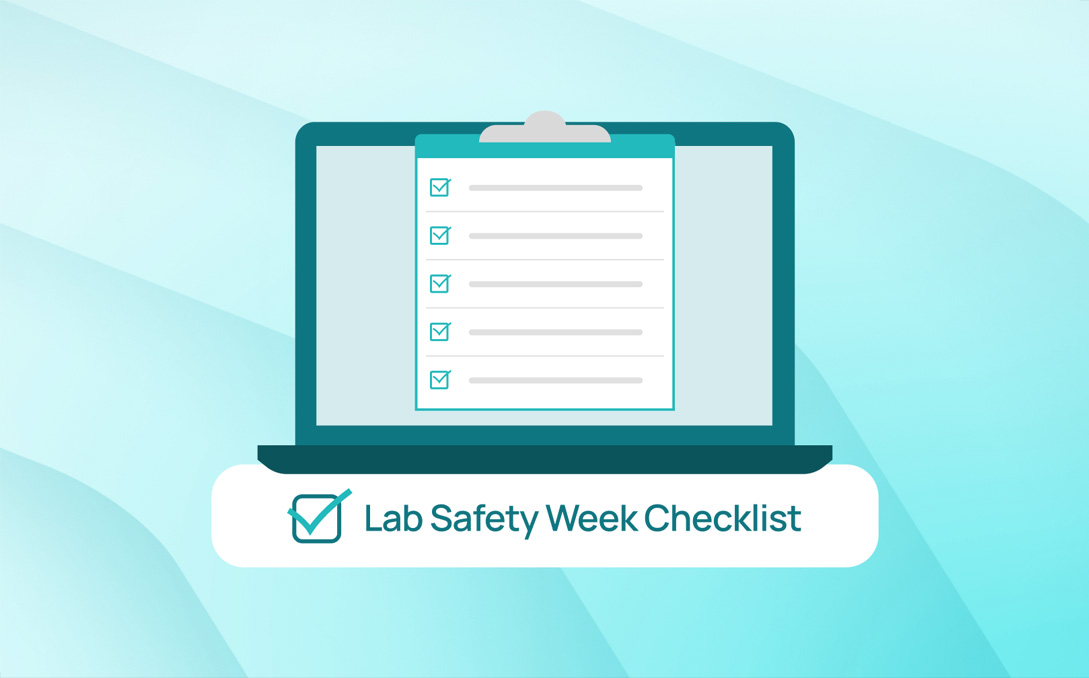
The Lab Safety Week Checklist

Treat this as a quick internal audit. If you can’t confidently say ‘yes,’ that’s your next improvement target.

1) SDS access

  • Anyone in the lab can find the right SDS in seconds (not minutes).
  • SDS are available in the work area at all times (not stored on one person’s desktop).
  • You have a simple way to keep SDS current as inventory changes.

Why this matters: OSHA’s Hazard Communication Standard (HazCom) requires hazard information—including SDS—be available to workers, and HazCom continues to show up as a frequent citation area. (OSHA)

2) Labeling (Especially Secondary Containers)

  • Primary containers are labeled and readable.
  • Secondary containers are labeled in a way that gives everyone clear hazard info.
  • “Temporary” labels don’t become permanent mysteries.

Why this matters: OSHA includes specific labeling requirements under HazCom, and it’s one of the easiest things to miss during busy bench work. (OSHA)

3) Training Records

  • Required training is up to date.
  • Defined, clear method for determining and documenting who needs what training.
  • Records are centralized and easy to pull, without digging through email threads or shared drives.

Why this matters: Even when training happens, proving it happened can be the hard part—especially under audit pressure and when the training was run by someone else.

4) Incidents & Near-Misses

  • Reporting is easy and centralized (not buried across inboxes and spreadsheets).
  • Near-miss reporting is encouraged and focused on learning, not blame.
  • Near-misses turn into visible follow-ups (so people trust the process).

Why this matters: Research surveys show lab injuries and near-misses are not rare events in academic settings (Carolina Digital Repository) and an organization’s response to near misses can affect the occurrence rates of occupational incidents (Journal of Occupational Health, Volume 66, Issue 1, January-December 2024, uiae053, https://doi.org/10.1093/joccuh/uiae053). Near-misses are early warning signals. They reveal gaps in controls, training, or processes before someone gets hurt.  

5) Inspections & Corrective Actions

  • You have a clear view of what’s been inspected, what’s overdue, and what’s next.
  • Findings have owners and due dates (not “we’ll get to it”).
  • Repeat findings are tracked (visibility to make sure problem scenarios actually get addressed).

Why this matters: Inspections only work if findings turn into changes—otherwise they’re just paperwork.

6) Hazardous Waste Basics

  • Waste containers are labeled correctly and consistently.
  • Containers are closed except when adding/removing waste.
  • Waste streams are segregated per your program requirements.
  • Satellite accumulation rules are followed (where applicable).

Why this matters: EPA rules for satellite accumulation include requirements like keeping containers closed and labeling containers (e.g., “Hazardous Waste,” plus other specifics). (eCFR)

7) Samples & Materials (Traceability)

  • You can trace where materials came from, where they went, and who handled them.
  • Storage location and status are current, with a clear source of truth.
  • Chain-of-custody expectations (if applicable) are clear and followed.

Why this matters: Traceability supports both safety (knowing what’s where) and research integrity (knowing what happened to a sample).

8) “Proof On Demand”

  • If an auditor asked today, you could produce key records fast:
  • SDSs and chemical inventory lists
  • Training records
  • Recent inspection logs + corrective actions
  • Incident and near-miss records
  • Waste handling documentation (as applicable)

If a few of these feel like a heavy lift, that’s normal. Most labs are working with processes that grew organically—over years, by multiple people, and with too many spreadsheets—so keeping everything aligned takes more effort than it should.

Proactive Vs. Reactive Lab Safety (And Why Proactive Always Wins)

Reactive safety looks like:

  • “We’ll fix that if someone notices.”
  • “We’ll address it if it becomes a problem.”
  • “We’ll talk about it after the inspection.”

Proactive safety looks like:

  • “We’ll catch it while it’s still small.”
  • “We’ll make the safe path the easy path.”
  • “We’ll turn near-misses into opportunities for improvement.”

A few reminders on why proactive matters:

  • Hazard Communication (HazCom) remains one of OSHA’s most frequently cited standards—year after year. (OSHA)
  • In a 2024 assessment of lab safety training, ~20% of surveyed students reported experiencing a lab injury, and larger percentages reported observing near-misses. (Carolina Digital Repository)
Shape

Five Low-Friction Safety Moves You Can Do This Week

1) The 60-Second SDS Test

Pick a chemical you use weekly. Ask a new lab member to pull the SDS.

If it takes more than 60 seconds, you’ve found a friction point.

Support: OSHA emphasizes that SDS are a core part of HazCom and should be accessible to employees. (OSHA)

2) A Two-Minute Label Sweep

Walk one bench. Look for:

  • Unlabeled bottles
  • Fading labels
  • Abbreviations only the original owner understands

OSHA HazCom includes workplace labeling expectations, and secondary containers are a common place for drift. (OSHA)

3) Waste Reality Check

Take a quick look at your most-used waste area:

  • Is each container labeled correctly?
  • Is it closed except when adding/removing?
  • Are incompatible wastes segregated?

EPA guidance and regulations commonly reinforce “closed container” expectations. (eCFR)

4) One “RAMP” Moment Before A New Step

Before a new procedure (or a scale-up), take 60 seconds:

RAMP = Recognize hazards, Assess risks, Minimize risks, Prepare for emergencies. (institute.acs.org)

It’s quick, memorable, and it works—especially when research is moving fast.

5) Make Near-Miss Reporting Easy (And Blame-Free)

If people feel blamed, they stay quiet.

If reporting is simple and psychologically safe, you learn faster. ACS Chemical Health & Safety has practical guidance on capturing and using near-miss reports. (American Chemical Society Publications)

The Real Unlock: Remove The “Where Is That Document?” Scramble

Proactive safety sticks when the right info shows up where work is happening:

  • SDS access
  • Training records
  • Inspection schedules and findings
  • Incidents and near-misses
  • Inventory and traceability

SciSure Health & Safety (EHS) helps labs keep those records connected to day-to-day operations—so audits become routine, not a fire.

Quick Poll for Your Lab Team:

What tends to get attention in your lab only when there’s a problem or audit coming?: labels, SDS access, waste storage, or training records?

Lab Safety Awareness Week Quick Checklist

SDS, Training, Inspections, Incidents, Waste, Traceability, & “Proof on Demand”
How to use: Treat this as a quick internal audit. If you can’t confidently check “Yes,” that’s your next improvement target.

Area Checklist Item Check
Training Required trainings have been completed for current roles
Records are centralized, trackable, and easy to pull for an audit
New-hire onboarding training is consistent and documented
Incidents & Near-Misses Reporting is straightforward, not buried in email threads
Near-miss reporting is non-punitive and encouraged
Reports turn into follow-ups, with owners and due dates
Inspections You can see what’s been checked, what’s overdue, and what’s next
Findings have owners and due dates
Repeat findings are tracked so issues don’t keep coming back
Labeling (Secondary Containers) Primary containers are labeled and readable
Secondary containers are labeled clearly, no unclear abbreviations
Temporary labels don’t linger
Hazardous Waste Basics Waste containers are labeled correctly for your program
Containers are closed except when adding or removing waste
Waste streams are segregated per program requirements
Samples & Materials You can trace where materials came from, where they went, and who handled them
Storage locations and status are current
Chain-of-custody expectations are clear and followed, if applicable
Proof On Demand You can demonstrate how SDSs are accessed
You can readily share current training records
You can instantly provide inspection logs and corrective actions
You can produce incident and near-miss logs
You can easily find waste handling documentation
You can access key records without scrambling
Low-Friction Safety Moves 60-second SDS test for a commonly used chemical
Two-minute label sweep on one bench
Waste reality check: labeled, closed, and segregated
One RAMP moment before a new step
Near-miss reporting is easy and blame-free

Sources

  • OSHA — Top 10 most frequently cited standards (OSHA)
  • OSHA — Commonly used statistics (most frequently violated standards) (OSHA)
  • OSHA — Hazard Communication Standard (29 CFR 1910.1200) (OSHA)
  • OSHA — Hazard Communication: Safety Data Sheets (OSHA 3514) (OSHA)
  • OSHA — Secondary container labeling interpretation (OSHA)
  • EPA / eCFR — Satellite accumulation area requirements (40 CFR 262.15) (eCFR)
  • EPA — “Closed container” clarification (frequent questions) (US EPA)

Ready to see SciSure in action?

Get a personalized demo and see how SciSure fits your lab's workflows.
Request demo

No commitment · Free consultation

If safety and compliance feels like a second job, you’re not imagining it.

Labs today must balance research and a growing stack of compliance requirements: SDS management, training documentation, waste rules, inspections, incident logs, inventory traceability…the list doesn’t stop.

Lab Safety Awareness Week is a good moment to do a quick reset. Not a massive overhaul. Just a targeted, high-impact checklist run-through to help you stay proactive (instead of scrambling right before an inspection or audit!).

We’re sharing a practical checklist you can run in under an hour, along with a few low-friction action steps you can knock out this week.

The Lab Safety Week Checklist

Treat this as a quick internal audit. If you can’t confidently say ‘yes,’ that’s your next improvement target.

1) SDS access

  • Anyone in the lab can find the right SDS in seconds (not minutes).
  • SDS are available in the work area at all times (not stored on one person’s desktop).
  • You have a simple way to keep SDS current as inventory changes.

Why this matters: OSHA’s Hazard Communication Standard (HazCom) requires hazard information—including SDS—be available to workers, and HazCom continues to show up as a frequent citation area. (OSHA)

2) Labeling (Especially Secondary Containers)

  • Primary containers are labeled and readable.
  • Secondary containers are labeled in a way that gives everyone clear hazard info.
  • “Temporary” labels don’t become permanent mysteries.

Why this matters: OSHA includes specific labeling requirements under HazCom, and it’s one of the easiest things to miss during busy bench work. (OSHA)

3) Training Records

  • Required training is up to date.
  • Defined, clear method for determining and documenting who needs what training.
  • Records are centralized and easy to pull, without digging through email threads or shared drives.

Why this matters: Even when training happens, proving it happened can be the hard part—especially under audit pressure and when the training was run by someone else.

4) Incidents & Near-Misses

  • Reporting is easy and centralized (not buried across inboxes and spreadsheets).
  • Near-miss reporting is encouraged and focused on learning, not blame.
  • Near-misses turn into visible follow-ups (so people trust the process).

Why this matters: Research surveys show lab injuries and near-misses are not rare events in academic settings (Carolina Digital Repository) and an organization’s response to near misses can affect the occurrence rates of occupational incidents (Journal of Occupational Health, Volume 66, Issue 1, January-December 2024, uiae053, https://doi.org/10.1093/joccuh/uiae053). Near-misses are early warning signals. They reveal gaps in controls, training, or processes before someone gets hurt.  

5) Inspections & Corrective Actions

  • You have a clear view of what’s been inspected, what’s overdue, and what’s next.
  • Findings have owners and due dates (not “we’ll get to it”).
  • Repeat findings are tracked (visibility to make sure problem scenarios actually get addressed).

Why this matters: Inspections only work if findings turn into changes—otherwise they’re just paperwork.

6) Hazardous Waste Basics

  • Waste containers are labeled correctly and consistently.
  • Containers are closed except when adding/removing waste.
  • Waste streams are segregated per your program requirements.
  • Satellite accumulation rules are followed (where applicable).

Why this matters: EPA rules for satellite accumulation include requirements like keeping containers closed and labeling containers (e.g., “Hazardous Waste,” plus other specifics). (eCFR)

7) Samples & Materials (Traceability)

  • You can trace where materials came from, where they went, and who handled them.
  • Storage location and status are current, with a clear source of truth.
  • Chain-of-custody expectations (if applicable) are clear and followed.

Why this matters: Traceability supports both safety (knowing what’s where) and research integrity (knowing what happened to a sample).

8) “Proof On Demand”

  • If an auditor asked today, you could produce key records fast:
  • SDSs and chemical inventory lists
  • Training records
  • Recent inspection logs + corrective actions
  • Incident and near-miss records
  • Waste handling documentation (as applicable)

If a few of these feel like a heavy lift, that’s normal. Most labs are working with processes that grew organically—over years, by multiple people, and with too many spreadsheets—so keeping everything aligned takes more effort than it should.

Proactive Vs. Reactive Lab Safety (And Why Proactive Always Wins)

Reactive safety looks like:

  • “We’ll fix that if someone notices.”
  • “We’ll address it if it becomes a problem.”
  • “We’ll talk about it after the inspection.”

Proactive safety looks like:

  • “We’ll catch it while it’s still small.”
  • “We’ll make the safe path the easy path.”
  • “We’ll turn near-misses into opportunities for improvement.”

A few reminders on why proactive matters:

  • Hazard Communication (HazCom) remains one of OSHA’s most frequently cited standards—year after year. (OSHA)
  • In a 2024 assessment of lab safety training, ~20% of surveyed students reported experiencing a lab injury, and larger percentages reported observing near-misses. (Carolina Digital Repository)
Shape

Five Low-Friction Safety Moves You Can Do This Week

1) The 60-Second SDS Test

Pick a chemical you use weekly. Ask a new lab member to pull the SDS.

If it takes more than 60 seconds, you’ve found a friction point.

Support: OSHA emphasizes that SDS are a core part of HazCom and should be accessible to employees. (OSHA)

2) A Two-Minute Label Sweep

Walk one bench. Look for:

  • Unlabeled bottles
  • Fading labels
  • Abbreviations only the original owner understands

OSHA HazCom includes workplace labeling expectations, and secondary containers are a common place for drift. (OSHA)

3) Waste Reality Check

Take a quick look at your most-used waste area:

  • Is each container labeled correctly?
  • Is it closed except when adding/removing?
  • Are incompatible wastes segregated?

EPA guidance and regulations commonly reinforce “closed container” expectations. (eCFR)

4) One “RAMP” Moment Before A New Step

Before a new procedure (or a scale-up), take 60 seconds:

RAMP = Recognize hazards, Assess risks, Minimize risks, Prepare for emergencies. (institute.acs.org)

It’s quick, memorable, and it works—especially when research is moving fast.

5) Make Near-Miss Reporting Easy (And Blame-Free)

If people feel blamed, they stay quiet.

If reporting is simple and psychologically safe, you learn faster. ACS Chemical Health & Safety has practical guidance on capturing and using near-miss reports. (American Chemical Society Publications)

The Real Unlock: Remove The “Where Is That Document?” Scramble

Proactive safety sticks when the right info shows up where work is happening:

  • SDS access
  • Training records
  • Inspection schedules and findings
  • Incidents and near-misses
  • Inventory and traceability

SciSure Health & Safety (EHS) helps labs keep those records connected to day-to-day operations—so audits become routine, not a fire.

Quick Poll for Your Lab Team:

What tends to get attention in your lab only when there’s a problem or audit coming?: labels, SDS access, waste storage, or training records?

Lab Safety Awareness Week Quick Checklist

SDS, Training, Inspections, Incidents, Waste, Traceability, & “Proof on Demand”
How to use: Treat this as a quick internal audit. If you can’t confidently check “Yes,” that’s your next improvement target.

Area Checklist Item Check
Training Required trainings have been completed for current roles
Records are centralized, trackable, and easy to pull for an audit
New-hire onboarding training is consistent and documented
Incidents & Near-Misses Reporting is straightforward, not buried in email threads
Near-miss reporting is non-punitive and encouraged
Reports turn into follow-ups, with owners and due dates
Inspections You can see what’s been checked, what’s overdue, and what’s next
Findings have owners and due dates
Repeat findings are tracked so issues don’t keep coming back
Labeling (Secondary Containers) Primary containers are labeled and readable
Secondary containers are labeled clearly, no unclear abbreviations
Temporary labels don’t linger
Hazardous Waste Basics Waste containers are labeled correctly for your program
Containers are closed except when adding or removing waste
Waste streams are segregated per program requirements
Samples & Materials You can trace where materials came from, where they went, and who handled them
Storage locations and status are current
Chain-of-custody expectations are clear and followed, if applicable
Proof On Demand You can demonstrate how SDSs are accessed
You can readily share current training records
You can instantly provide inspection logs and corrective actions
You can produce incident and near-miss logs
You can easily find waste handling documentation
You can access key records without scrambling
Low-Friction Safety Moves 60-second SDS test for a commonly used chemical
Two-minute label sweep on one bench
Waste reality check: labeled, closed, and segregated
One RAMP moment before a new step
Near-miss reporting is easy and blame-free

Sources

  • OSHA — Top 10 most frequently cited standards (OSHA)
  • OSHA — Commonly used statistics (most frequently violated standards) (OSHA)
  • OSHA — Hazard Communication Standard (29 CFR 1910.1200) (OSHA)
  • OSHA — Hazard Communication: Safety Data Sheets (OSHA 3514) (OSHA)
  • OSHA — Secondary container labeling interpretation (OSHA)
  • EPA / eCFR — Satellite accumulation area requirements (40 CFR 262.15) (eCFR)
  • EPA — “Closed container” clarification (frequent questions) (US EPA)

Inscrivez-vous à notre newsletter

Recevez les derniers conseils, articles et contenus exclusifs sur la gestion moderne des laboratoires dans votre boîte de réception.
Merci ! Votre candidature a été reçue !
Please check your email to verify your submission.
Oups ! Une erreur s'est produite lors de l'envoi du formulaire.